
Command Palette
Search for a command to run...
Command Palette
Search for a command to run...
Why Video Games Use Fake Gun Names: Licensing, Trademarks, and Creative Freedom
From the Kastov 762 to the M5A3, the guns in your favorite shooters are almost-real. Here's the full story behind why Battlefield, Call of Duty, and GTA rename their weapons — and why it matters.

The Kastov 762, the M5A3, and the Art of the Almost-Real Gun
If you've put time into Call of Duty: Modern Warfare II, you've handled the Kastov 762 — a magazine-fed, gas-operated rifle that every shooter instantly recognizes as an AK-103. You've run the Lachmann Sub, which anyone familiar with Heckler & Koch immediately identifies as an MP5. In Battlefield 2042, the M5A3 assault rifle is clearly derived from the SIG-Sauer MCX-SPEAR. In GTA V, the "Carbine Rifle" is a barely-disguised M4A1. Across virtually every major first-person shooter and action game released in the past decade, real firearms are present in spirit — renamed, slightly redesigned, and operating under a system of deliberate legal and commercial camouflage. Understanding why this happens reveals a surprising amount about trademark law, corporate image management, and the economics of game development.
A Brief History: When Games Used Real Names Freely
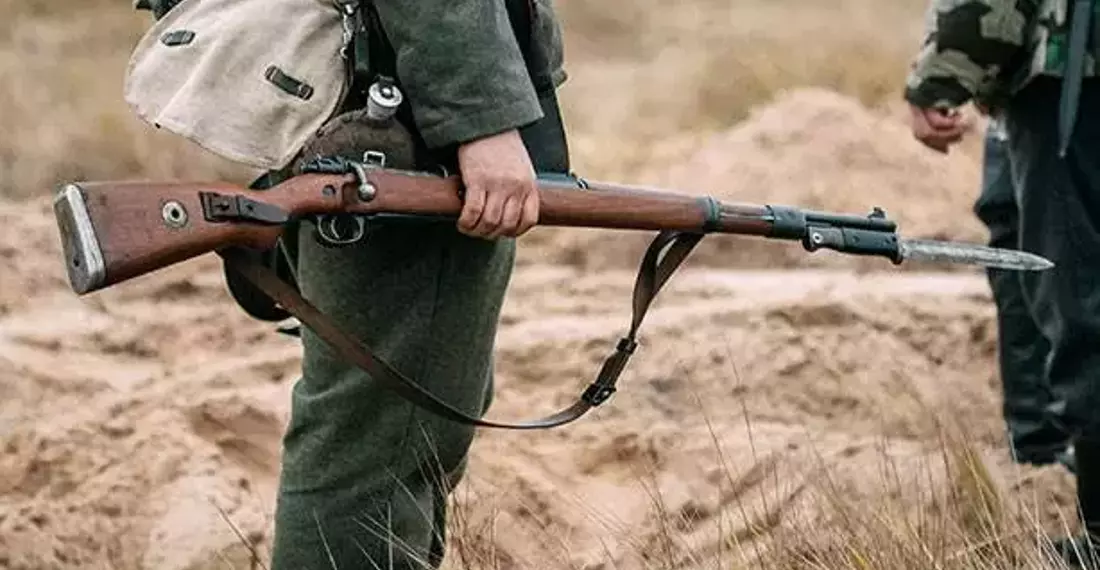
It wasn't always like this. Throughout the 1990s and early 2000s, video games routinely named weapons after their real-world counterparts without incident. The original Counter-Strike (2000) featured the M4A1, the AK-47, the Glock 18, the Desert Eagle, and the AWP (Arctic Warfare Police) — all named correctly, all modeled recognizably. Early Call of Duty titles set during World War II freely referenced the M1 Garand, the Thompson submachine gun, the MP40, and the Kar98k by their real designations. The underlying logic was simple: these weapons were historical, their manufacturers no longer had active commercial stakes in policing game appearances, and the legal concept of "trade dress" protection for consumer products was not yet being aggressively applied to the interactive entertainment industry.
The Trademark and Trade Dress Problem
The central legal issue is not copyright — it is trademark and trade dress. A firearm's name (like "Glock," "MP5," or "AK-47") can be a registered trademark. Its visual design — the specific combination of shape, color, texture, and configuration that makes a product recognizable — is protected as "trade dress" under U.S. trademark law. When a game recreates a weapon so accurately that consumers could mistake it for an endorsement or official licensing deal, the manufacturer can claim trade dress infringement. Heckler & Koch, maker of the MP5, has been particularly active in this space: the MP5-inspired "Lachmann Sub" in Modern Warfare II (2022) appears to have been redesigned specifically around elements that H&K had contested in prior legal proceedings against game publishers. The general principle holds across the industry: if a gun maker's lawyers decide your game is commercially benefiting from their brand without permission, you can be sued — and defending that lawsuit is expensive regardless of whether you win.
The Three Models: License, Disguise, or Create
Game developers have settled into three distinct approaches for dealing with real-world weapon IP. The first is to license the weapons properly. Escape from Tarkov (2017–present), the hardcore Russian extraction shooter by Battlestate Games, is the most prominent example: its developers have confirmed publicly that a portion of the game's budget is allocated specifically to licensing agreements with manufacturers including Heckler & Koch, Kalashnikov Concern, and others. The result is arguably the most authentic firearms simulation in commercial gaming — down to correct part names, accurate animations, and licensed manufacturer markings on receivers. The second approach is to rename and minimally redesign: keep the visual silhouette and mechanical function recognizable enough that players know exactly what they're using, but change the name and modify small details to avoid the direct trademark claim. This is the strategy employed by Activision in the Modern Warfare series and by DICE in Battlefield 2042. The third option is to design original fictional weapons that may be inspired by real firearms families but are distinct enough to stand alone — common in science-fiction and fantasy games where a futuristic setting provides creative cover.
Battlefield's "Authentic Fiction" Strategy
DICE's approach with Battlefield 2042 is particularly instructive because the developers have been unusually open about it. Alexander Formoso, who oversaw weapon implementation for the game, explained that the studio creates "fictional designations" that still follow the naming conventions real manufacturers use — because doing so preserves player recognition while sidestepping trademark exposure. The M5A3, for example, clearly draws on the SIG-Sauer MCX-SPEAR platform and its NGSW (Next Generation Squad Weapon) program lineage, with its in-game lore stating it was adopted as the standard US military rifle in 2034. The PBX-45 submachine gun visually replicates the LWRC SMG-45. Players familiar with the real weapons immediately recognize them; the name change provides just enough legal distance. The same philosophy appears to govern Battlefield 6's weapon naming, where community discussions have noted that nearly every weapon in the game is a recognizable analogue of a real firearm operating under a fictional designation. Fans on Steam have joked that the names "read like they were generated by an algorithm" — which is, in a sense, precisely the goal: plausible-but-proprietary nomenclature.
Why Some Manufacturers Say No
Licensing isn't simply a matter of money — some manufacturers have actively chosen not to license their products to video games at all, regardless of the fee offered. The reasons cited across industry accounts include brand association concerns: a manufacturer whose product is used extensively in a violent game may worry about reputational damage, particularly if the game depicts civilian mass-violence scenarios or controversial political conflicts. Beretta, Colt, and several other storied American manufacturers have at various points been either restrictive or entirely absent from licensing discussions with major game publishers. Additionally, licensing deals typically come with conditions — the manufacturer may require that the weapon behave realistically, that it not be depicted as malfunctioning, or that it not be associated with criminal characters. These editorial constraints can conflict with game designers' creative needs. Meanwhile, PUBG: Battlegrounds stands as a notable counterexample: the game uses accurate real-world weapon names including the SCAR-L, the M416, the AKM, and the AWM — suggesting that either licensing deals were negotiated or, more likely, that the specific weapons chosen fell outside active trademark enforcement because of their age, their government/military origin, or the manufacturers' indifference to the gaming market.
The Modding Community's Response
One of the most telling indicators of how much this issue matters to players is the size and persistence of the modding community dedicated to restoring real gun names. For GTA V, dozens of widely-downloaded mods on GTA5-Mods.com rename the "Carbine Rifle" back to the M4A1, the "Pistol" back to the Glock, and so on. For Ready or Not, a tactical shooter that ships with fictionalized names, mods restoring real names regularly rank among the most popular downloads. The message from the player community is clear: firearm enthusiasts who play these games value authenticity, and they will invest their own time to add it back when developers remove it for legal reasons. This dynamic has not been lost on studios — it represents both a tacit acknowledgment that their naming choices are commercially motivated rather than creatively preferred, and an ongoing reminder of the market value of accuracy.
What This Means for the Firearms Community
For gun owners and firearms enthusiasts, the renaming phenomenon is a reminder that the firearms industry's relationship with popular culture is complicated and commercially significant. Games like Escape from Tarkov — with its licensed weapons and fanatically accurate mechanics — have demonstrably driven sales of real-world accessories and generated awareness for manufacturers whose products appear authentically in-game. Conversely, manufacturers who refuse licensing deals or take aggressive legal action against games may be protecting their trademark while sacrificing a massive free advertising platform reaching tens of millions of players worldwide. As the video game industry has grown to surpass film and music combined in global revenue, the question of whether to license a firearm to a game — and at what cost and under what conditions — has become a genuine strategic decision for arms manufacturers' marketing departments. The "Kastov 762" may be a legal fiction, but the consumer who looks it up, recognizes the AK-103, and then spends an evening reading about 7.62×39mm ballistics is a very real outcome for the industry.

Sources: Kakuchopurei — Why Call of Duty's Guns Have Fake Names | IMFDB — Battlefield 2042 | Sportskeeda — Why CoD Weapons Have Different Names | Steam Community Guide — Why Video Game Guns Have Weird Names | Avvo Legal Answers — Real Weapon Names in Games
Written by
Eugene Warren
The Gun Database contributor