
Command Palette
Search for a command to run...
Command Palette
Search for a command to run...
The SIG Sauer P226: How a Lost Contract Built an Eternal Legend
The P226 outperformed every rival in the 1984 U.S. military trials — then lost the contract on price. What happened next turned a procurement defeat into one of the most trusted service pistols in history.

In 1984, the SIG Sauer P226 entered the U.S. Army's XM9 pistol trials and outperformed every competitor in reliability. It was more accurate, had fewer stoppages, and felt better in the hand than anything else on the range. It also lost the contract — on price. The Beretta 92F cost less per unit when spare parts and magazines were included in the total package, and the Pentagon went with Beretta. It was the kind of outcome that makes procurement history interesting and military history ironic: the gun that won on merit lost on spreadsheets, then went on to become one of the most trusted service pistols ever made.
The P226's story is about what happens when a firearm is too good to stay obscure. It found a different customer — one who cared far less about package pricing and far more about whether the gun would work when it absolutely had to.
The XM9 Trials: Competition Born from Crisis
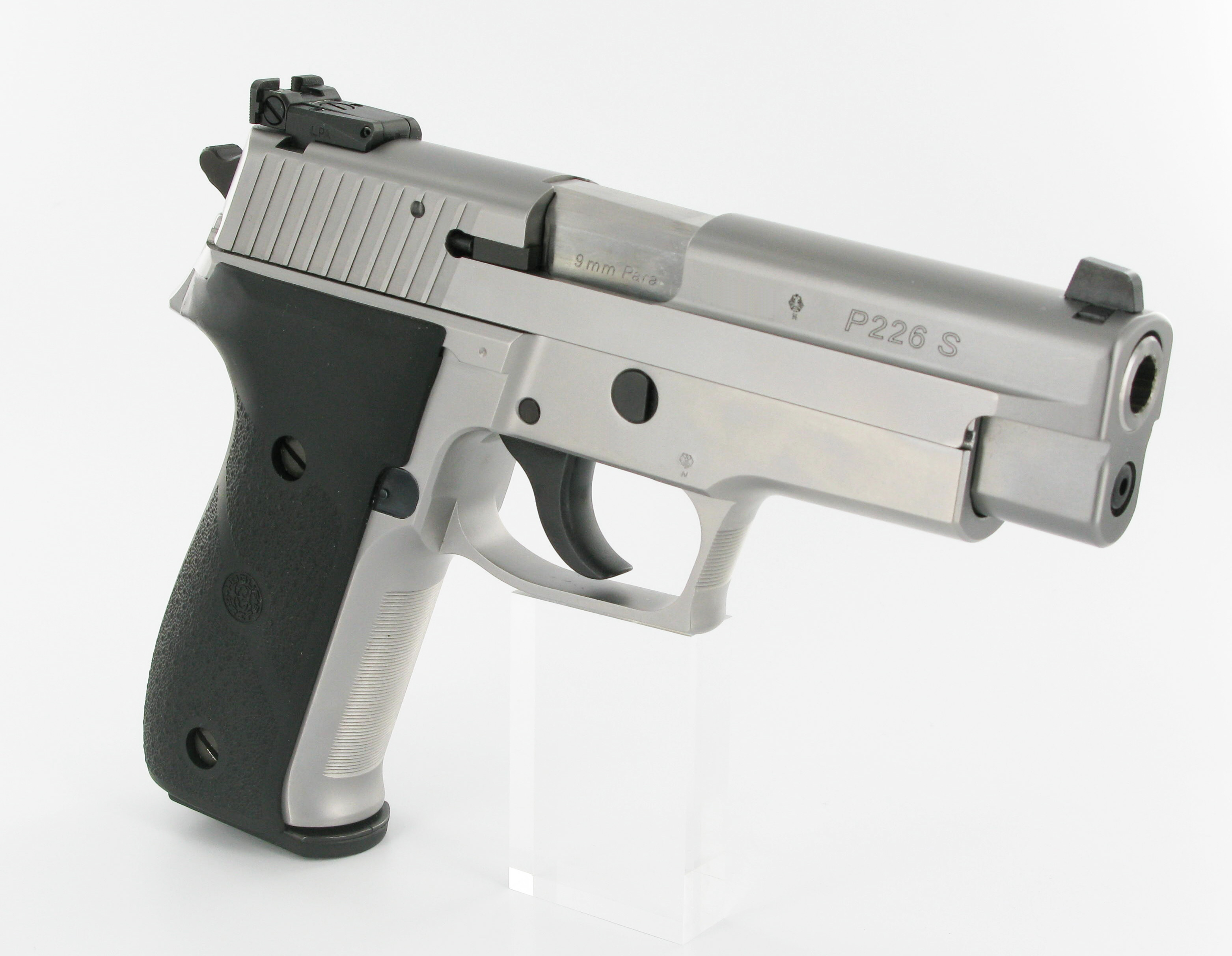
By the late 1970s, the U.S. military was still issuing the M1911A1, a single-action .45 ACP pistol that had been in continuous service since 1911. NATO standardization on the 9×19mm Parabellum cartridge, combined with the obvious age of the 1911 platform, pushed the Joint Service Small Arms Program to launch the XM9 trials — a comprehensive evaluation to find a modern replacement sidearm for all branches of the military.
SIG Sauer's response was the P226. Derived from the existing P220, the P226 was widened to accept a double-stack 15-round magazine — a dramatic capacity advantage over the 1911's 7+1. The operating system used a recoil-operated, locked-breech design with a DA/SA trigger: a long, heavy double-action first pull for the first shot, then crisp single-action for every shot after. The pistol's aluminum alloy frame kept weight manageable at 34 ounces loaded, while the steel slide provided the durability that military service demands.
In the 1984 trials, the P226 recorded just 12 stoppages against the Beretta's 20 — a clear reliability advantage. Both guns passed all testing phases, making them the only two pistols to do so. The Beretta won the contract regardless, its total procurement package undercutting SIG's bid. The Army got its Beretta M9. The Navy SEALs got their attention.
The Beretta Incident and the SEAL Decision
In the late 1980s, reports began surfacing of Beretta M9 slide failures during training. Slides on Italian-manufactured pistols — specifically those made with a different metallurgical specification than U.S.-produced units — were cracking under sustained high-pressure fire. In at least three documented cases, SEAL operators were injured when slide components came free during firing. The failures were traced to substandard metal toughness in that production batch, not to the M9 design as a whole — but for a community that couldn't tolerate any uncertainty in their sidearm, the M9's credibility was damaged.
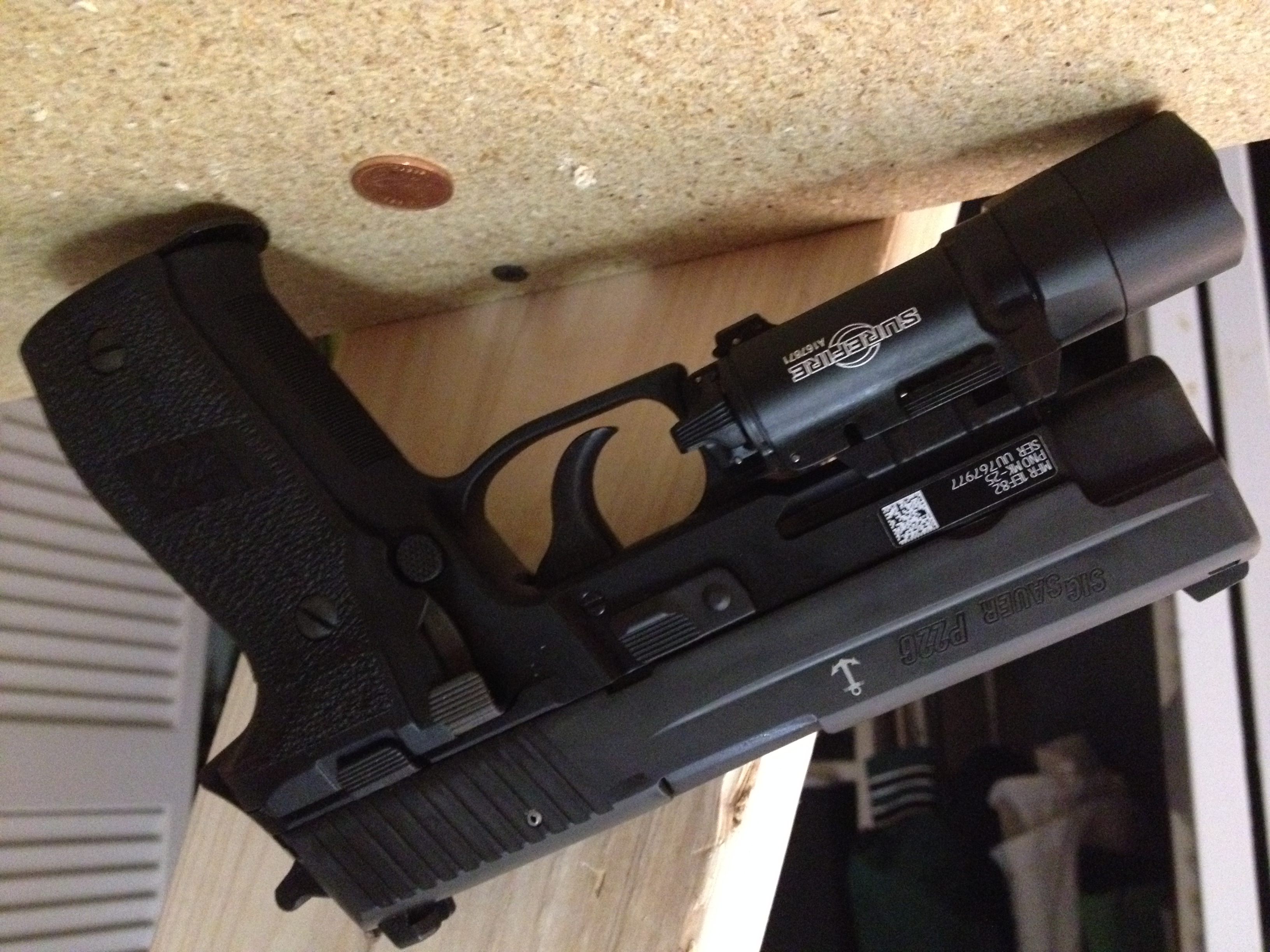
The SEALs went shopping. They evaluated the P226 and found in it exactly what the XM9 trials had already documented: a pistol that ran reliably, pointed naturally, and handled the punishment of extended training without complaint. In 1989, Naval Special Warfare Command officially adopted the P226, designating it the Mk 24 Mod 0. The pistol was subsequently updated and redesignated the Mk 25 in 2011, which added a standard M1913 Picatinny rail for light and laser attachments, SIGLITE tritium night sights, and enhanced internal corrosion-resistant coatings critical for a unit that operates regularly in saltwater environments.
The anchor engraved on the Mk 25's slide became one of the most recognized marks in special operations culture. DEVGRU (SEAL Team Six) carried the P226 on the most sensitive missions in U.S. history. That association cemented the P226's reputation in a way no advertising campaign ever could.
Why It's a Classic: The Design That Got It Right

The P226 works because its fundamentals are sound. The DA/SA trigger system gives it two distinct modes of operation: the first shot requires a deliberate, longer pull that functions as an inherent safety — the firing pin block prevents discharge from any force other than the trigger. Subsequent shots drop to a lighter, more precise single-action pull. This system has been criticized by some for requiring the shooter to manage two different trigger feels, but proponents argue it delivers both safety and performance without compromise.
The aluminum alloy frame is a key contributor to the P226's handling. Steel-framed pistols are heavier but more durable over extreme round counts; polymer frames are lighter but can flex under heavy use. The P226's aluminum frame sits between those extremes — lighter than steel, stiffer than polymer, and able to absorb the recoil impulse of the 9mm more predictably. The resulting balance point, with weight distributed close to the hand rather than at the muzzle, gives the pistol its characteristic pointability.
The barrel uses a cam-locking Browning-derived system that locks the barrel to the slide at the moment of firing, then unlocks during recoil cycling. This is fundamentally the same system used by the 1911 and Glock, but SIG's execution — combined with the longer 4.4-inch barrel — produces a sight radius and ballistic consistency that shooters consistently reward with tight groups. The P226 is, by any objective measurement, an exceptionally accurate pistol out of the box.
Add the ambidextrous controls, the robust extractor, the fired-case ejection that works even at extreme angles, and the de-cocker that safely drops the hammer from single-action without firing — and you have a platform that covers nearly every scenario a serious user might encounter.
Reported Problems: What the Critics Found
No gun with the P226's service life is without documented issues, and the P226 is no exception. The most significant concern in the platform's history involved early alloy frames — specifically, some German-manufactured frames from the 1980s and early 1990s that developed cracks along the frame rails after extended use. Baltimore County Police Department reported cracks in 52 of approximately 1,300 P226 pistols during routine inspection. Investigation pointed to a combination of worn recoil springs (which allow the slide to slam harder against the frame) and, in some cases, a metallurgical issue with specific production batches. SIG redesigned the frame rail geometry and the problem effectively disappeared in later production.
More recent complaints have focused on the PVD (Physical Vapor Deposition) finish applied to some variants, particularly the P226 Legion series. Owners reported that the finish showed wear unusually quickly — sometimes after fewer than 100 rounds — where the slide contacts the frame interior. SIG acknowledged the concern and offered DLC (Diamond-Like Carbon) coating upgrades for affected pistols. The functional reliability of the guns was not compromised; the issue was cosmetic and a matter of finish durability expectations at the pistol's price point.
A third concern occasionally raised is the single-action trigger pull after de-cocking during a high-stress situation — an ergonomic challenge that requires training to manage consistently. Some law enforcement agencies moved to DAO (Double Action Only) configurations specifically to eliminate the variable trigger feel. This is more a system characteristic than a flaw, and it explains why SIG later introduced striker-fired options for agencies wanting a simpler manual of arms.
Variants and the Legion Legacy

The P226 has spawned one of the most extensive variant families in modern handgun history. The P228 (U.S. military M11) is a compact version adopted by the Army's Criminal Investigation Division and multiple federal agencies. The P229 uses a heavier, milled-steel slide suitable for higher-pressure cartridges like .357 SIG and .40 S&W. The P224 is a subcompact derivative for concealed carry. Each shares the core P226 operating system and trigger philosophy.
The 2010 P226 E2 (Enhanced Ergonomics) refined the grip with a shorter trigger reach and new grip panels — a direct response to shooter feedback about the original's distance from backstrap to trigger. The E2 made the platform more accessible to a wider range of hand sizes without altering the fundamental action.
The Legion series, introduced in 2015, represents SIG's most premium iteration of the P226 platform. Legion pistols feature a skeletonized trigger, enhanced action job, X-GRIP magazine extension compatibility, and a signature grey PVD finish. The Legion is aimed squarely at serious competitors and collectors who want a factory-tuned P226 without aftermarket work — and despite the finish criticisms noted above, the Legion's action quality is widely praised.
The P226 Elite Dark — with its black nitron finish, night sights, and accessory rail — became a favorite among law enforcement tactical units who wanted the SEAL-proven platform in a more aggressively configured package.
A Pistol That Earned Its Place
The SIG Sauer P226 has been in continuous production for over four decades. It has served with Navy SEALs, the FBI, the Secret Service, the German Federal Police, the British SAS, Canadian Special Forces, and dozens of other agencies that chose their sidearms based on operational need rather than contract pricing. It was carried on missions in Mogadishu, Afghanistan, Iraq, and locations that will never appear in official records.
Its eventual replacement in SEAL service — the Glock 19 has increasingly supplemented the P226 in special operations due to weight savings and polymer durability — doesn't diminish what the P226 accomplished. It held a position of absolute trust in the most demanding community in American military culture for over three decades. That record is the only resume a pistol needs.
The P226 didn't win the contract. It won something harder to earn: a reputation built entirely on performance, one confirmed mission at a time.
Sources: Wikipedia — SIG Sauer P226 | SOFREP | National Interest | SIG Sauer Inc. | AmmoLand | The Firearm Blog | USCCA
Written by
Eugene Warren
The Gun Database contributor