
Command Palette
Search for a command to run...
Command Palette
Search for a command to run...
Revolvers in 2026: Why the Wheel Gun Refuses to Die
A $3.45 billion market, Colt Python sellouts, and law enforcement history — the revolver is 190 years old and still very much alive. Here's the full story.

The Wheel Gun in 2026: Still Spinning
In a market dominated by striker-fired polymer pistols with 15-round magazines and red-dot sights, the revolver should be a relic — a museum piece that politely stepped aside when Gaston Glock arrived in America in 1985. It didn't. In 2026, the revolver market is valued at approximately $3.45 billion and is projected to grow to $4.99 billion by 2032, at a compound annual growth rate of 5.4%. Smith & Wesson produced 196,279 revolvers in 2023 alone, making it the top revolver manufacturer in the United States. Ruger followed with 177,366 and continues to grow. The Colt Python — reintroduced in 2020 after a long production hiatus — ranked as the top-selling revolver on GunBroker in 2024. The wheel gun is not dying. The real question is why.
A Mechanism Built on Simplicity — And That Still Matters
The revolver's core design has remained essentially unchanged since Samuel Colt patented the percussion revolver in 1836. A rotating cylinder holds individual cartridges. Pulling the trigger rotates the cylinder, aligns a chamber with the barrel, cocks and drops the hammer. No slide. No extractor. No magazine spring. No feed ramp. This mechanical simplicity is the revolver's foundational argument — and it remains completely valid in 2026. A revolver will fire reliably regardless of how it is held, regardless of whether the ammunition is underpowered or loaded wrong, and regardless of whether it has been sitting in a safe for a decade. There are no stovepipes, no failure-to-feed malfunctions, and no limp-wristing issues. When a round fails to fire, the shooter simply pulls the trigger again and the cylinder rotates to the next chamber. For a semi-automatic pistol, a dud means a manual stoppage drill.
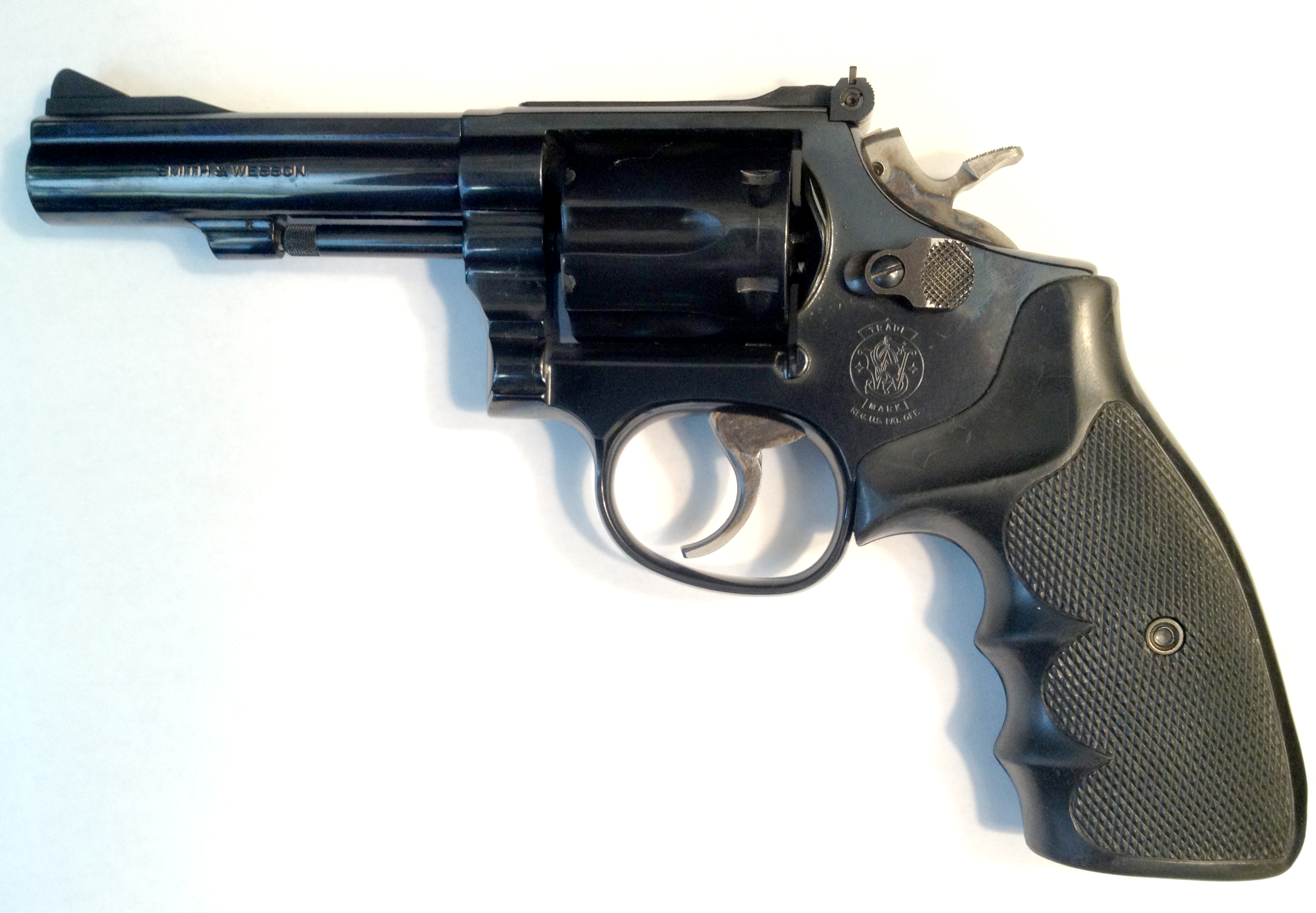
The Smith & Wesson Model 15-7 — a classic K-frame double-action revolver in .38 Special. The K-frame served US law enforcement for decades before the semi-auto transition. Image: Euxomai, CC BY-SA 3.0.
Concealed Carry, Hunting, and the Niches Where Revolvers Dominate
Snub-nosed revolvers — compact double-action wheelguns with 2-inch barrels, typified by the Smith & Wesson J-frame series and the Ruger LCR — occupy a specific niche in the concealed carry market that semi-autos have never fully displaced. Their round profile sits more comfortably against the body in pocket carry, they have no external hammer to snag on clothing, and their operation is so simple that minimal training is required for basic proficiency. The S&W Model 642, a hammerless Airweight .38 Special, remains one of the best-selling revolvers in the United States year after year for exactly these reasons.

The Smith & Wesson Model 36 Chief's Special — a 2-inch .38 Special snub-nose revolver. The J-frame platform remains one of the best-selling concealed carry revolvers in the United States. Image: Judson Guns / Self Loader, CC BY-SA 4.0.
At the other end of the power spectrum, revolvers dominate the hunting handgun market. The Smith & Wesson Model 500 in .500 S&W Magnum, the Ruger Super Redhawk in .454 Casull, and the Freedom Arms Model 83 in .500 Wyoming Express offer energy levels that no semi-automatic pistol can approach in a comparable package. Trail carry in bear country is also a revolver stronghold — a .44 Magnum revolver carried by hikers and hunters offers a level of terminal energy and reliability that no compact semi-auto can match.
The Collector Boom: Colt Python, S&W Model 29, and the Heritage Market
One of the most significant drivers of the modern revolver market is collectibility. The Colt Python, originally manufactured from 1955 to 2005, became the most coveted production revolver in American history — original examples in excellent condition regularly sell for $3,000–$6,000 or more. When Colt reintroduced the Python in 2020 (chambered in .357 Magnum), demand was overwhelming. The 2020 Python immediately became the top seller in its category and validates the reverence the shooting community still has for fine revolver craftsmanship. Similarly, the Smith & Wesson Model 29 — the .44 Magnum revolver made famous by the Dirty Harry films — commands strong premiums on the secondary market. Heritage Rough Rider single-action revolvers also topped GunBroker sales charts in 2024, appealing to Western-style and cowboy action shooting enthusiasts.

A 1959 Colt Python in .357 Magnum — original examples of this iconic revolver now command $3,000–$6,000+ on the collector market. Image: lifesizepotato, CC0 / Public Domain.
The Real Drawbacks: Where Revolvers Genuinely Fall Short
Honest discussion of revolvers requires acknowledging their limitations — and they are real. Capacity is the most significant: standard revolvers carry five or six rounds, compared to 15–17 for a compact 9mm semi-auto like the Glock 19 or SIG P365. In a defensive scenario involving multiple threats, that difference matters. Reload speed compounds the problem. Even with a speedloader — a circular device that drops all rounds into the cylinder simultaneously — a trained shooter reloading a revolver under stress is still slower than an experienced semi-auto shooter performing a magazine swap. Only the most practiced wheelgun shooters can approach semi-auto reload times, and even then the gap rarely closes entirely. Double-action trigger pulls on revolvers are also typically heavier and longer than striker-fired semi-autos, which can challenge accuracy for less experienced shooters. Finally, the cylinder itself makes revolvers wider through the frame than semi-autos, which can complicate deep concealment in appendix or pocket carry positions.
Law Enforcement's Break-Up With the Revolver
For most of the 20th century, the revolver was the standard law enforcement sidearm across the United States. The FBI's first issued service weapon was a Colt Official Police .38 Special revolver in 1934. The Smith & Wesson Model 13 — a .357 Magnum K-frame — served as the FBI's last issued revolver until 1991. The transition away from revolvers was not gradual; it was triggered by a single traumatic event. On April 11, 1986, eight FBI agents engaged two armed bank robbers in Miami, Florida. The majority of agents were carrying revolvers with six-round cylinders. Two FBI agents were killed and five were wounded in what became known as the 1986 Miami Shootout. The inadequacy of limited-capacity revolvers in a sustained gunfight became impossible to ignore. By the early 1990s, virtually every major US law enforcement agency had transitioned to semi-automatic pistols. Today, no major US federal or municipal law enforcement agency issues revolvers as a standard sidearm.
Is There Still a Market? The Answer Is Unambiguously Yes
The revolver market in 2026 is not a niche for nostalgia buffs and it is not on life support. Smith & Wesson, Ruger, Taurus, Colt, and Kimber all maintain active revolver product lines. Ruger's Mark Gurney has stated publicly that "we sell all we can make" regarding both single-action and double-action revolver demand. The revolver buyer in 2026 typically falls into one of several distinct profiles: the concealed carrier who prioritizes simplicity and reliability over capacity; the hunter who needs serious power from a handgun; the collector chasing fine craftsmanship or specific historical models; the cowboy action or ICORE competitive shooter; or the new shooter being introduced to firearms who benefits from the revolver's forgiving manual of arms. None of these groups is shrinking. The revolver isn't for everyone — and in 2026 it doesn't need to be. It has found its lanes, and it owns them.
Sources: 19FortyFive — Revolver: Old But Reliable | American Rifleman — GunBroker Most Popular Guns 2024 | Shooting Industry Magazine — Firearms Report 2024 | Inside Safariland — Firearms of the FBI | Liberty Safe — Best New Revolvers 2025 | USCCA Blog — Semi-Auto vs Revolver
Written by
Eugene Warren
The Gun Database contributor