
Command Palette
Search for a command to run...
Command Palette
Search for a command to run...
How Polymer Pistols Took Over: The Rise of the Plastic Fantastic (1970–Today)
From the overlooked H&K VP70 to the Glock revolution and the SIG M17, here's how polymer-framed pistols went from curiosity to global standard.

The Age of Steel: How Handguns Were Built Before Polymer
For most of the 20th century, the handgun was a product of metal — steel frames, steel slides, steel barrels, all assembled with the precision of a finely tuned machine. Iconic service pistols like the Colt M1911, the Walther P38, and the Browning Hi-Power defined generations of military and law enforcement sidearms through their robust all-metal construction. These were reliable, durable, and proven in combat across two world wars and dozens of smaller conflicts. But they were also heavy, expensive to manufacture, and limited in what ergonomic or design improvements could be made without fundamentally rethinking the materials they were built from. By the late 1960s, a handful of engineers — most notably in Germany — began asking a different question: what if the frame wasn't metal at all?
The First Attempt: Heckler & Koch VP70 (1970)
In 1970, Heckler & Koch introduced the Volkspistole 70 — the VP70 — a pistol that would make firearms history as the first production handgun to feature a polymer frame. Work on the design had begun as early as 1968, and the VP70 was remarkable for its time: an 18-round double-stack magazine, a fully ambidextrous design, and a frame constructed from high-impact thermoplastic rather than steel or aluminum. H&K's engineers recognized that synthetic polymers offered compelling advantages — lower production costs, resistance to corrosion, and reduced weight. Unfortunately, the broader firearms market was not ready. The VP70 was awkward to handle, featured a heavy double-action-only trigger, and saw limited military adoption in a handful of nations including Portugal, Lebanon, and Brazil. No major military power picked it up, and production ended in 1989. The VP70 was a brilliant idea stranded too far ahead of its time — a proof of concept that planted a seed the rest of the industry would eventually harvest.

The Game Changer: Gaston Glock and the Glock 17 (1982)
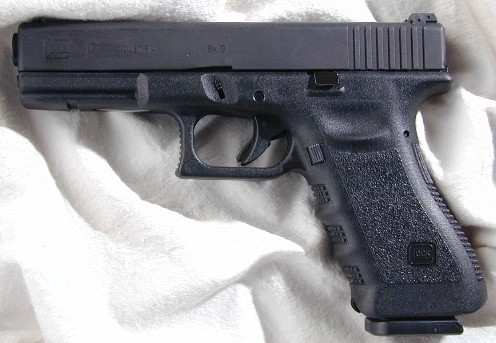
The man who truly unlocked the polymer pistol's potential had no background in firearms design at all. Gaston Glock was an Austrian engineer and curtain-rod manufacturer with deep expertise in advanced synthetic polymers when, in 1980, the Austrian Armed Forces announced a competition for a new service pistol. Glock entered with a clean-sheet design that leveraged exactly what he knew: high-strength nylon-based polymer for the frame, a simple striker-fired mechanism with just 34 components, and a radically streamlined geometry that prioritized function over tradition. In 1982, after outperforming competitors from H&K, SIG Sauer, Beretta, and Steyr in rigorous Austrian Army trials — including a test where the Glock was frozen, submerged, dropped into sand, and fired thousands of rounds without malfunction — the pistol was adopted as the Pistole 80 (P80). Commercially, it would be known as the Glock 17. In January 1986, the first Glock 17s landed in the United States. Law enforcement agencies took notice almost immediately.
Law Enforcement Converts the Market
The adoption of polymer-framed pistols by American law enforcement throughout the late 1980s and 1990s was the inflection point that cemented the technology's dominance. By 1988, the Miami Metro-Dade Police Department had adopted the Glock 17, followed by the FBI in 1997, which made the transition from the Smith & Wesson Model 1076 to the Glock 23. The advantages that drove these decisions were concrete and repeatable: the Glock 17 weighed approximately 22 ounces unloaded — nearly a full pound lighter than the all-steel Beretta M9 it competed with. Its 17-round magazine capacity exceeded most service pistols of the era. Maintenance was simplified, training was faster, and the polymer frame was immune to the corrosion that plagued steel-framed pistols carried in humid or maritime environments. By the mid-1990s, over half of American law enforcement agencies had either adopted Glock pistols or approved them for carry. The steel-framed service pistol had not disappeared, but it was clearly on the defensive.
The Beretta M9 Era and Its Limitations
It is worth understanding what polymer frames were displacing. The Beretta M9, adopted by the U.S. military in January 1985 to replace the Colt M1911A1, was an all-metal, double/single-action pistol chambered in 9mm NATO. It was accurate, reliable, and held 15 rounds — a significant improvement over the 1911's 7-round magazine. But it weighed 33.3 ounces fully loaded and required a more complex manual of arms for safe operation: a cocked-and-locked carry mode for some operators, a decocking lever for others. Its metal frame, while durable, was heavier and costlier to manufacture than a polymer alternative. When the U.S. military held a new pistol competition in 2017, the M9 series was not competitive. The SIG Sauer M17 — a polymer-framed modular pistol — won the contract in one of the most consequential procurement decisions of the decade.

The Polymer Arms Race: S&W M&P, SIG P320, and the New Guard
Glock's dominance did not go unchallenged. By the 2000s, every major handgun manufacturer had either introduced a polymer-framed pistol or began developing one. Smith & Wesson launched the M&P (Military & Police) series in 2005, offering interchangeable grip inserts and a trigger system engineered with direct law enforcement input — it rapidly became Glock's most serious commercial rival. Springfield Armory brought the XD series (originally the HS2000, designed in Croatia) to American consumers, offering a grip safety in a striker-fired polymer platform. Walther produced the PPQ and later the PDP, earning praise for some of the best factory triggers in the striker-fired segment. The most consequential new entrant, however, was the SIG Sauer P320, a modular, polymer-framed striker-fired pistol introduced in 2014. The P320 won the U.S. Army's Modular Handgun System competition in January 2017, becoming the M17/M18 — the first new U.S. service pistol in 30 years, and a polymer-framed one at that.

Why Steel Fell Behind: Weight, Cost, and the Ergonomics Revolution
The decline of steel-framed handguns is not a story of inferiority — it is a story of advantages that compound. Polymer frames weigh significantly less: a standard Glock 17 frame weighs roughly 89 grams; an equivalent steel frame would weigh three to four times more. For an officer carrying a pistol on a duty belt for a 12-hour shift, or a soldier with an already-heavy combat load, that difference is meaningful. Manufacturing costs favor polymer decisively: a CNC-machined steel frame component costs an estimated $8.25 per part, versus approximately $2.50 for the equivalent polymer-molded component — a difference that scales to millions of dollars on large government contracts. Beyond economics, polymer frames enable design freedoms impossible in metal: aggressive grip texturing molded directly into the frame, integrated accessory rails, interchangeable backstraps and grip modules, and color customization at no added cost. Steel frames are not extinct — they remain dominant in competition shooting, 1911-pattern pistols, and the high-end custom market — but in the mainstream service pistol and concealed carry segments, polymer has achieved irreversible dominance, holding approximately 65% of the global service handgun market as of 2025.
What Polymer Dominance Means for Firearms Owners Today
For modern firearms owners, the polymer revolution has been almost entirely positive. Prices for reliable, duty-grade handguns have fallen significantly — quality polymer-framed pistols from Glock, Smith & Wesson, Ruger, and Taurus are available in the $300–$600 range that simply did not exist in the steel-frame era. The aftermarket ecosystem is vast: triggers, sights, frames, grip modules, and slides for polymer pistols dwarf what is available for steel-framed counterparts. Concealed carry has been transformed — polymer pistols are lighter and slimmer, making all-day carry more practical than it was with the steel service pistols of earlier decades. The direction of travel is clear: from the H&K VP70's lonely debut in 1970, through Gaston Glock's revolutionary gamble in 1982, to the SIG M17's adoption by the world's most powerful military in 2017, the polymer-framed pistol has moved from curiosity to experimental to standard — and the steel-framed handgun, while never fully gone, now occupies the niche that polymer once held.
Sources: Glock official history | National Interest — How Glock Won the Handgun War | Wikipedia — Heckler & Koch VP70 | Forgotten Weapons | U.S. Army MHS procurement records | Mordor Intelligence Service Handgun Market Report 2026
Written by
Eugene Warren
The Gun Database contributor