
Command Palette
Search for a command to run...
Command Palette
Search for a command to run...
Over The Top: WWI — The Game That Puts Authentic Trench Weapons in Your Hands
Over The Top: WWI delivers one of the most historically faithful arsenals in any video game — 50+ real WWI weapons, fully destructible trenches, and a brutal lesson in why the Great War was won with shovels as much as rifles.

Over The Top: WWI Brings the Real Arsenal of the Great War Into Your Hands
Flying Squirrel Entertainment's Over The Top: WWI isn't just another World War I shooter. Built by a small team of roughly four developers, the game has climbed Steam's charts with a 90% "Very Positive" rating by doing something most military shooters don't bother with: making the weapons, the trenches, and the tactical chaos of 1914–1918 feel genuinely real. For the firearms community especially, it's a title worth paying attention to — not as a perfect game, but as arguably the most authentic showcase of Great War small arms ever put in a player's hands.
Trench Warfare as a Core Mechanic, Not Just Scenery
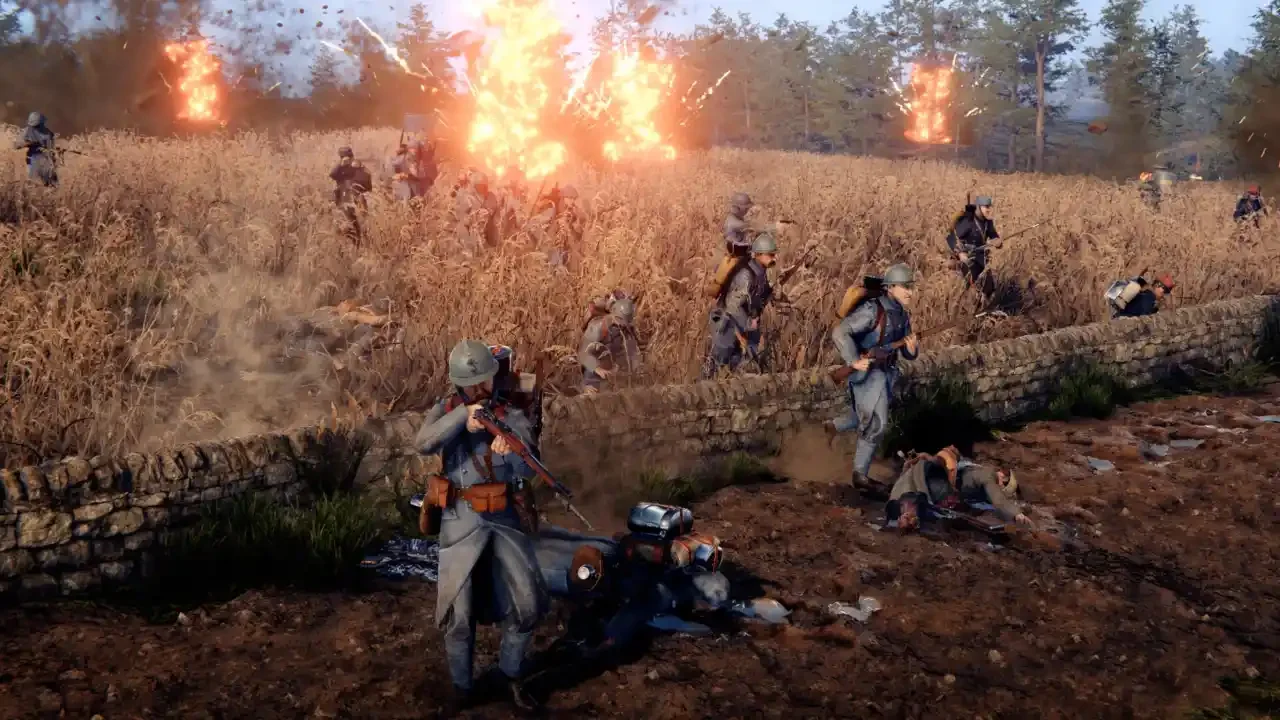
In most WWI games, trenches are background decoration — pre-built corridors you sprint through. Over The Top: WWI treats them as a living system. Engineers dig new trench lines in real time using shovels and pickaxes, carving zig-zagging networks of cover that force attackers to clear each segment individually, exactly as doctrine demanded in 1916. Artillery fire leaves permanent craters in the terrain, which soldiers can then exploit as fighting positions. Over the course of a 200-player match, what begins as a quiet French village gradually transforms into a mud-soaked WWI hellscape — terrain remade by the battle itself. The mechanic isn't just cosmetic: officers can call in creeping barrages and poison gas, and engineers can collapse enemy trench sections entirely. Survival depends far more on positioning and trench geometry than on raw aim. That fidelity to the tactical reality of the Western Front is what separates this title from its competitors.
50+ Historical Weapons — The Real Reason the Firearms Community Should Care
The headline number is over 50 historically accurate WWI weapons, and the roster is genuinely impressive. British players wield the Lee-Enfield SMLE, a rifle whose rapid bolt-cycling capability — demonstrated in the famous "Mad Minute" exercise where trained riflemen could land 20 to 30 hits at 300 yards in 60 seconds — made it the fastest-firing service bolt-action of the war. German forces field the Gewehr 98 and the Bergmann MP 18, the world's first practical submachine gun, developed specifically for trench clearing in 1918. Flamethrower specialists choose between the German Wechselapparat backpack system and the Schilt Lance Flamme — both documented weapons used in the war's earliest gas and fire attacks. The Heavy Gunner role puts players behind the Maschinengewehr 08, Germany's primary water-cooled machine gun, and the British Vickers M1 — weapons that could sustain fire for hours and fundamentally redefined what it meant to hold a defensive position. Anti-tank specialists get access to the Tankgewehr M1918, history's first purpose-built anti-tank rifle, chambered in 13.2×92mmSR and capable of penetrating the thin armor of early Allied tanks. Even the Winchester Model 1897 "Trench Gun" — the American pump-action shotgun famously protested by Germany under the 1907 Hague Convention for its devastating effect in close-quarters trench fighting — makes an appearance in the British faction's arsenal.
Eight Combat Roles Built Around How These Weapons Were Actually Deployed
The game's class system isn't arbitrary. Each of the eight roles maps directly to how Great War armies organized their fighting strength. The Rifleman is the backbone, armed with the period's standard-issue bolt-actions. The Engineer digs and demolishes. The Pyromaniac operates flamethrowers — a weapon so feared that operators on both sides were often shot on sight rather than taken prisoner. The Heavy Gunner mans crew-served machine guns and field artillery. The Officer directs support — calling in airstrikes, poison gas, and smoke screens, but with the responsibility of friendly fire: a careless barrage can devastate your own lines. Each role comes with historically accurate projectile physics, meaning range, drop, and stopping power reflect real-world ballistics rather than game-balanced approximations. For players who know their firearms history, watching the Maschinengewehr 08 overheat and require water cooling, or seeing the MP 18's drum magazine cycle at its actual rate of fire, delivers a level of authenticity that few games attempt.
The One Frustration: No Iron Sights
Here's where the game falls short for purists, and it's worth stating plainly: Over The Top: WWI does not feature iron sights. Aiming is handled through a screen-center crosshair rather than through the weapon's rear and front sight picture. For a game that goes to such lengths to replicate the physical reality of these firearms, the omission is genuinely jarring. The Steam community discussion threads have raised the issue repeatedly, and it remains unresolved. Rifle aiming over open sights — the way a Lee-Enfield or Gewehr 98 was actually used — is not currently part of the experience. The developers have flagged aiming bugs with heavy machine gun sights as under investigation, but the absence of true iron sight mechanics represents a gap between the game's historical ambition and its current execution. Whether that's a dealbreaker depends on what you're looking for. Those who come for the trench system, the weapons roster, and the scale of the battles will find plenty to enjoy. Those expecting the precision aiming experience of a dedicated military simulator will be disappointed.
The Historical Weapons of the Western Front — Why They Look the Way They Do
The weapons in Over The Top: WWI look strange to modern eyes for a reason. The Great War was fought at a transitional moment in firearms history: bolt-action rifles were at their tactical peak, semi-automatic infantry rifles didn't yet exist in meaningful numbers, and armies were improvising entirely new weapon categories — the submachine gun, the anti-tank rifle, the trench shotgun — in real time to solve problems that no one had anticipated before 1914. The Bergmann MP 18, for example, was designed specifically after the failure of traditional rifle-armed infantry to clear fortified trench positions quickly enough. The Tankgewehr M1918 was rushed into production within months of the British tank's debut on the Somme. Even the widespread use of flamethrowers was a direct response to the stalemate created by machine gun fire: if suppression wouldn't break a position, perhaps fire would. Playing through the weapon roster in this game is, in a real sense, a lesson in how the firearms industry was forced to innovate under extreme operational pressure — and why so many of those innovations directly shaped the weapons of the Second World War and beyond.
12 Maps, Destructible Everything, and What It All Adds Up To
The game launches with 12 maps, all inspired by historical WWI locations. Matches support up to 200 players — or bots, for those who want to experience the weapon roster without the pressure of live competition. Dynamic weather and time-of-day systems change visibility and conditions, mimicking the mud and fog that made night raids and dawn offensives the tactical cornerstone of the war. The maps progressively transform as matches unfold: craters accumulate, trench networks grow, and the terrain becomes a physical record of every artillery barrage and infantry charge that came before.
For the Firearms Community: An Imperfect But Valuable Window Into the Great War's Arsenal
No video game is a substitute for handling the actual firearms of the First World War, and Over The Top: WWI makes no claim to be a simulation in the strictest sense. But for enthusiasts who want to understand how the Lee-Enfield's rapid bolt action changed infantry tactics, why the MG 08 required a four-man crew to deploy and sustain, or what made the Tankgewehr M1918 both revolutionary and brutally impractical as a one-man weapon, this game offers context that a museum display or historical text cannot replicate. Seeing these weapons in their operational environment — behind a zig-zag trench line, under artillery fire, in the hands of the classes they were issued to — reveals something about their design logic that statistics alone don't capture. The iron sights omission is a real frustration, and one the developers should prioritize. But as a living encyclopedia of Great War small arms deployed in something approximating their actual tactical conditions, Over The Top: WWI stands apart from anything else currently available.
Sources: Steam — Over The Top: WWI | Happy Gamer | NotebookCheck | Games.GG Beginner Guide | Into Indie Games
Written by
Eugene Warren
The Gun Database contributor