
Command Palette
Search for a command to run...
Command Palette
Search for a command to run...
Non-Lethal CO2 Pistols for Home Defense: Is the T4E Line a Viable Option in 2026?
CO2-powered less-lethal launchers like the Umarex T4E have come a long way — but are they a genuine home defense option or just a backup plan? We break down the tech, the lineup, and the real limits.

The Rise of Less-Lethal Home Defense: A Serious Option or a Compromise?
For years, "non-lethal" home defense options were largely dismissed by the firearms community as underpowered novelties — paintball guns repackaged with a security pitch. In 2026, that calculus is changing. Companies like Umarex, with their Training for Engagement (T4E) product line, and Byrna Technologies have invested heavily in CO2-powered launchers designed specifically for civilian home defense scenarios. These platforms fire rubber balls, pepper-filled projectiles, and powder rounds at velocities that can genuinely stop a threat — all without the legal and psychological weight of a live firearm. But the question that matters most remains: are they actually a viable first line of defense?
What Is the T4E Line? Umarex's Less-Lethal Ecosystem
T4E — which stands for Training for Engagement — is Umarex's dedicated less-lethal platform, originally developed for law enforcement and military training before being made available to civilians. The line uses standard 12-gram CO2 cartridges to propel .50 or .68 caliber projectiles at velocities between 350 and 500 feet per second (FPS), depending on the model. What sets T4E apart from a standard airsoft or paintball gun is the range of purpose-built defensive ammunition it accepts: solid rubber balls for kinetic stopping power, pepper balls loaded with OC (oleoresin capsicum) irritant for chemical deterrence, and powder balls for marking. This multi-round versatility is central to T4E's home defense appeal — the same platform can de-escalate, deter, or physically stop a threat depending on what is chambered.
The Model Lineup: From Compact Pistol to Home Defense Shotgun
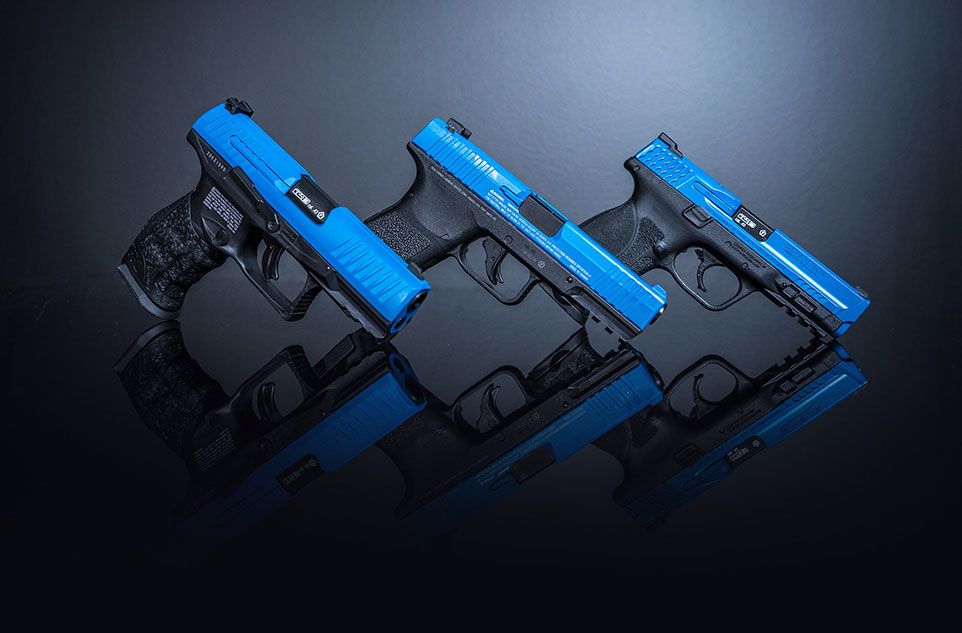
The T4E ecosystem now spans several distinct form factors aimed at different defensive scenarios. The T4E HDP 50 is the entry point — a semi-automatic .50 caliber pistol modeled on a compact handgun frame, capable of up to 485 FPS and 13 joules of muzzle energy, fed from an 8-round magazine. The T4E TR50 (also sold as the HDR 50 in some regions) takes a revolver format with a 6-round cylinder, delivering similar 13-joule output at approximately 430–455 FPS. Many users favor the revolver design for its mechanical simplicity and lower risk of a feed jam under stress. Stepping up considerably in power, the T4E HDS 68 is a .68 caliber double-barrel shotgun producing up to 34 joules per shot at around 500 FPS. At the top of the current lineup sits the T4E HDX 68 pump-action shotgun, pushing 50+ joules — making it among the most powerful less-lethal civilian platforms currently available.
How Far Has the Technology Come?
Early CO2-powered self-defense launchers of the 2010s were plagued by inconsistent velocity, poor cold-weather performance, and severely limited ammunition options. The T4E Gen 2 upgrades, rolled out progressively from 2021 through 2024, addressed several of these problems directly. Redesigned internal valve systems now produce more consistent pressure output across a broader temperature range, though CO2 platforms still lose meaningful velocity in sub-freezing conditions — a real consideration for home defense in colder climates. Projectile technology has also advanced significantly: today's .50 caliber pepper balls from Umarex and third-party manufacturers disperse an OC cloud with a 10–12 foot radius on impact, and newer compound rounds combine a solid rubber core with an OC coating for simultaneous kinetic and chemical effect. Reliability has measurably improved too — independent Gen 2 field tests have recorded zero malfunctions across multiple 50-round sessions, a stark contrast to the jam-prone earlier generation.
Real-World Effectiveness: What the Numbers Tell Us
At the muzzle, 13 joules — the rated output of the T4E HDP 50 and TR50 — is roughly equivalent to a high-powered air rifle. For comparison, a standard .22 LR round produces around 160 joules; a 9mm produces approximately 500 joules. The T4E's kinetic output is not designed to incapacitate through tissue damage the way a firearm round does. Instead, the defensive theory rests on a two-stage effect: the impact of a rubber ball at 430–485 FPS delivers genuine pain and physical disruption — capable of causing significant bruising, breaking skin, and potentially fracturing bones at close range — while chemical rounds add a disorienting OC cloud affecting the eyes and respiratory system for several minutes. Effective engagement range for the pistol platforms is typically cited at 20–30 feet for reliable accuracy and sufficient kinetic effect. Competitor Byrna Technologies, using a similar CO2 mechanism, claims a maximum effective range of 60 feet for its kinetic projectiles — suggesting the technology ceiling for these platforms is still being pushed upward.
The Hard Limits: What "Less-Lethal" Cannot Guarantee
The term "non-lethal" is a label the industry itself has largely abandoned in favor of "less-lethal" — and for good reason. At close range, a rubber ball traveling at 480 FPS can cause serious injury, and there are documented cases of less-lethal projectiles causing fatalities in law enforcement applications, particularly with head or throat impacts. The T4E line is no exception; these are not toys, and a non-fatal outcome cannot be guaranteed in every use case. There are also practical home defense limitations that deserve candid acknowledgment. CO2 cartridges require replacement after approximately 40–80 shots depending on the platform — fine for training sessions, but demanding attention to readiness in a real defensive context. Cold storage conditions can reduce CO2 pressure and degrade velocity. And most critically: against a determined, armed attacker, a less-lethal launcher that fails to immediately stop the threat leaves the defender in a dangerous position with no immediate escalation option. For this reason, many experienced home defense advisors recommend these platforms as a complement to — rather than a replacement for — a conventional firearm.
The Legal Advantage: No Background Check, No Federal License
One of the most significant practical advantages of the T4E line and similar CO2 platforms is their legal accessibility. Under federal law in the United States, CO2-powered launchers are not classified as firearms and therefore require no background check, waiting period, or federal purchase license. They can be ordered online and shipped directly to the buyer in most states — making them relevant for individuals legally prohibited from owning conventional firearms, apartment dwellers wary of over-penetration, or buyers who want a defensive option while working through the traditional purchase process. State laws vary considerably, however: California and New York restrict or prohibit the shipment of pepper-based projectiles, and some municipalities regulate CO2-powered devices in specific contexts. It is also worth noting that while purchase requires no permit, using a less-lethal launcher in a defensive incident still carries potential legal consequences — including criminal liability if the force is deemed excessive — just as any use of force does.
Who Should Seriously Consider the T4E Platform?
The T4E line and similar CO2-based less-lethal systems have matured enough to deserve genuine consideration in specific scenarios. Apartment dwellers concerned about over-penetration of conventional rounds through shared walls gain a meaningful reduction in collateral risk. Households with children who find safe storage of live ammunition a persistent challenge may find a quick-access less-lethal launcher offers a different safety profile. Homeowners who prefer a de-escalation tool before committing to lethal force, or who simply choose not to keep a live firearm in the home, now have a platform that delivers real stopping capability rather than a symbolic deterrent. The 2026 T4E ecosystem is unrecognizable compared to the rebranded paintball novelties marketed for "self-defense" a decade ago. Whether it is the right primary choice for any individual home depends on specific circumstances, layout, and threat assessment — but the technology has genuinely earned a place in the conversation.
Sources: Umarex USA — T4E Product Line (umarexusa.com) | Replica Airguns — T4E P2P HDP 50 Gen 2 Field Test Review | Self Defense Gear Co. — TR50 Home Defense Review | USA Self Defense Centers — Best Non-Lethal Pistol Comparison 2025 | Byrna Technologies FAQ (byrna.com) | WF Defense — Legality of Non-Lethal Air Guns for Self Defense
Written by
Eugene Warren
The Gun Database contributor