
Command Palette
Search for a command to run...
Command Palette
Search for a command to run...
The Glock Switch: How a Tiny Illegal Device Is Fueling a Full-Auto Crime Wave
A coin-sized device costing as little as $50 can transform any Glock pistol into a fully automatic weapon firing 1,200 rounds per minute. Here's what the Glock switch is, how criminals use it, and why federal law bans it with up to 10 years in prison.

The Glock Switch: A Coin-Sized Device That's Fueling a Full-Auto Crime Wave
It weighs less than an ounce, fits in the palm of your hand, and can be 3D-printed for under $10 or bought on the black market for as little as $50. Yet this tiny piece of machined metal or plastic — known as a "Glock switch" — has become one of the most alarming weapons accessories in America today. By slipping onto the rear of a Glock pistol in seconds, it converts a standard semi-automatic handgun into an illegal fully automatic machine gun capable of emptying a 17-round magazine in under a second. Law enforcement agencies across the country are calling its proliferation an epidemic, and the numbers back that up: ATF recoveries of these devices surged 784% between 2019 and 2023.
What Exactly Is a Glock Switch?
A Glock switch — formally known as a machine gun conversion device (MCD) or auto sear — is an aftermarket accessory engineered to defeat the semi-automatic fire mechanism built into Glock pistols. In a standard Glock, each trigger pull fires exactly one round; the trigger bar re-engages after each shot, preventing continuous fire. An auto sear physically interrupts that re-engagement sequence, allowing the pistol to continue firing as long as the trigger is depressed and ammunition remains in the magazine.
The result is staggering: a Glock 17 or Glock 19 equipped with a switch can fire at rates of up to 1,200 rounds per minute — rivaling military-grade submachine guns. Most consumer handgun magazines hold between 15 and 33 rounds, meaning a full magazine can be discharged in one to two seconds of sustained trigger depression. The device typically mounts to the rear slide cover plate of the pistol and requires no gunsmithing — it installs in under a minute with no tools.
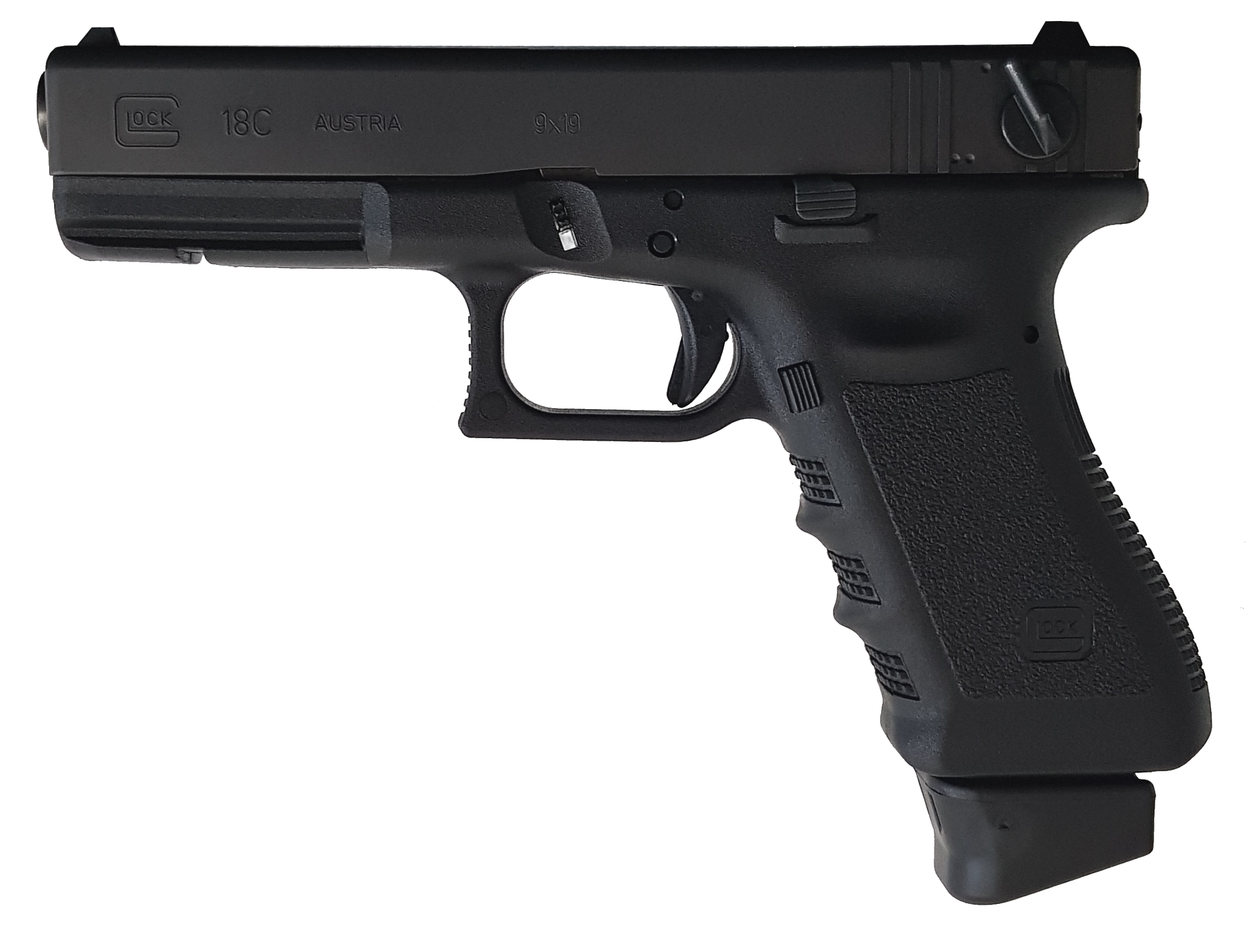
The Glock 18C — Glock's own factory-produced full-auto variant, strictly limited to military and law enforcement. The Glock switch is a crude illegal attempt to replicate this capability on any standard Glock pistol. (Photo: AmmuNation, CC BY-SA 4.0)
How Criminals Are Using It — and the Devastation It Causes
In criminal hands, the Glock switch transforms an already deadly weapon into something categorically more dangerous. The sheer volume of rounds that can be fired in a burst makes target discrimination nearly impossible and dramatically increases the probability of hitting unintended victims. Law enforcement investigators have linked these devices to murders, attempted murders, drive-by shootings, witness intimidation, and mass casualty events.
In September 2024, a mass shooting in Birmingham, Alabama resulted in over 100 shell casings being recovered at the scene — a volume only possible through automatic or near-automatic fire. Investigators believe the shooters used conversion devices attached to their handguns. That same year, 28 cities across the United States reported a combined 1,100+ Glock switch recoveries at crime scenes, representing a seven-fold increase over 2020 figures in cities with continuous data. In Baton Rouge, Louisiana, prosecutors documented over 80 criminal cases in just two years involving Glock switches, spanning charges from murder to terrorizing neighborhoods.

Crime scenes involving Glock switches are often characterized by the sheer number of shell casings — a telltale sign of fully automatic fire. (Photo: Tony Webster, CC BY-SA 2.0)
Beyond homicide statistics, the public safety implications are profound. Automatic fire in an urban environment is extraordinarily indiscriminate. Rounds travel through walls, vehicles, and crowds. Innocent bystanders — including children — have been struck and killed in incidents where a shooter equipped with a Glock switch opened fire in a residential area or public space. The device effectively negates any remaining margin of safety between a handgun and a weapon of war.
Why the Glock Switch Is Federally Banned
Under federal law, a Glock switch is not treated as an accessory — it is legally classified as a machine gun in its own right. This classification flows from the National Firearms Act (NFA) of 1934 and the Firearm Owners' Protection Act (FOPA) of 1986. The NFA defines a machine gun as any part designed and intended solely to convert a semi-automatic weapon into a machine gun. The switch meets that definition precisely, which means the device itself — even sitting unattached in a drawer, even if 3D-printed and never installed — is an illegal machine gun under federal law.
FOPA went further by banning civilian transfer or possession of any machine gun manufactured after May 19, 1986. Since every Glock switch ever made postdates that cutoff by decades, there is no legal pathway for a civilian to own one. Possession carries a federal penalty of up to 10 years in federal prison and a fine of up to $250,000. Manufacturing, selling, or trafficking them adds additional federal charges that can result in sentences well exceeding a decade. In 2023, one convicted trafficker of 3D-printed Glock switches was sentenced to over seven years in federal prison by the ATF.

ATF investigators display weapons seized during federal enforcement operations. Machine gun conversion devices are now a central target of ATF enforcement. (Photo: FBI, Public Domain)
The Scale of the Problem: ATF's Epidemic Warning
The ATF has used the word "epidemic" — and the data justifies it. Law enforcement recovered just 658 machine gun conversion devices nationwide in 2019. By 2023, that number had exploded to 5,816 in a single year — a 784% increase in four years. In total, more than 11,000 devices were recovered between 2019 and 2023 alone. The ATF reports a 570% increase in MCD recoveries over the past decade.
What's driving this explosion? Two factors stand out. First, global supply chains: beginning around 2019, thousands of switches were imported from Chinese manufacturers and seized by Customs officials, revealing an international pipeline. Second, and more difficult to interdict, is 3D printing. Since 2021, functioning Glock switches have been freely available as downloadable print files online, allowing anyone with a consumer-grade 3D printer to manufacture them at home for the cost of a few cents of plastic filament. This has decentralized production in a way traditional enforcement tools struggle to address.
State Laws and the Push for Tougher Restrictions
While federal law already bans Glock switches outright, several states have moved to enact their own dedicated legislation — partly to create additional prosecutorial tools and partly to address gaps in state-level enforcement. In 2024, Maryland became one of the first states to pass a law specifically naming Glock switches and auto sears, imposing state-level felony penalties on top of federal charges. New York proposed legislation targeting the underlying pistol designs that enable easy switch installation. Stateline reported in 2025 that a growing number of state legislatures are actively considering similar measures.
In June 2024, the U.S. Department of Justice launched Operation Texas Kill Switch, a statewide federal initiative specifically targeting the trafficking and possession of machine gun conversion devices. The operation resulted in dozens of arrests and seizures across Texas, signaling a ramped-up federal posture on enforcement.
What This Means for Law-Abiding Firearm Owners
For the millions of responsible, law-abiding Glock owners, the rise of the Glock switch presents a reputational and political challenge. The platform's enormous popularity — Glocks are the best-selling pistol line in the United States and are carried by roughly 65% of American law enforcement agencies — means that criminal misuse inevitably generates legislative scrutiny of the firearms themselves, not just the illegal accessories. New York's proposed legislation, for instance, would restrict the sale of certain Glock models that are deemed too easily converted.
The distinction between a lawfully owned Glock and one fitted with an illegal switch is absolute — but that distinction can be blurred in public discourse and policy debate. Understanding what these devices are, why they are banned, and how they are being used is essential context for anyone engaged in the broader conversation about firearms policy in America. A Glock switch is not a gray-area accessory or a regulatory footnote — it is a federally banned machine gun that has demonstrably contributed to mass casualty events, and enforcement of the existing law remains one of the central challenges facing American law enforcement in 2026.
Sources: ATF Press Releases | Everytown for Gun Safety Crime Gun Report | NPR: Maryland Bans Glock Switches (2024) | CNN: Conversion Devices and Birmingham Shooting (2024) | Giffords Law Center | The Trace: ATF Auto Sear Regulation | WAFB: 80+ Cases in Baton Rouge | DOJ: Operation Texas Kill Switch | Stateline: States Move to Outlaw Glock Switches (2025)
Written by
Eugene Warren
The Gun Database contributor