
Command Palette
Search for a command to run...
Command Palette
Search for a command to run...
Desert Eagle: The Hand Cannon That Conquered Gaming and Pop Culture
Born in Minnesota, refined in Israel, and immortalized in gaming — the Desert Eagle .50 AE is the most famous hand cannon ever built. Here's the full story behind the Deagle.

There are guns built to be used, and then there are guns built to be felt. The Desert Eagle belongs to the second category. Chambered in .50 Action Express — the largest centerfire cartridge ever stuffed into a magazine-fed semi-automatic pistol — it is objectively oversized, operationally demanding, and practically impossible to conceal. It is also one of the most recognized firearms on Earth. That gap between practicality and fame is exactly what makes the Desert Eagle worth understanding.
Born in Minnesota, Refined in Israel
The Desert Eagle's origin story is more American than its Israeli reputation suggests. In 1979, a pair of Minnesota entrepreneurs — Jim Skildum and John Risdall of Magnum Research Inc. (MRI) — set out to build a semi-automatic pistol capable of firing revolver-class cartridges. The engineering challenge was substantial: semi-autos typically operate via recoil or blowback, but the massive pressures of magnum cartridges demanded something different.
The solution was a gas-operated, rotating-bolt mechanism — the same operating principle used in military rifles like the AR-15 and AK-47. Gases tapped from the barrel cycle the action, allowing the gun to handle cartridges that would destroy a conventional semi-auto. The patent application was filed in January 1983, and the first production Desert Eagles came to market that same year chambered in .357 Magnum.
Magnum Research brought Israel Military Industries (IMI) in as manufacturing partner, and the partnership proved fruitful. IMI's engineering expertise helped refine the design, and the gun's Israeli production credentials added to its mythological aura. Manufacturing has moved around over the decades — to Saco Defense in Maine in 1995, back to IMI in 1998 — and since December 2009, every Desert Eagle has been assembled at MRI's facility in Pillager, Minnesota. Kahr Arms acquired Magnum Research in 2010 and continues to produce the pistol today.
The .50 AE: Numbers That Sound Fictional
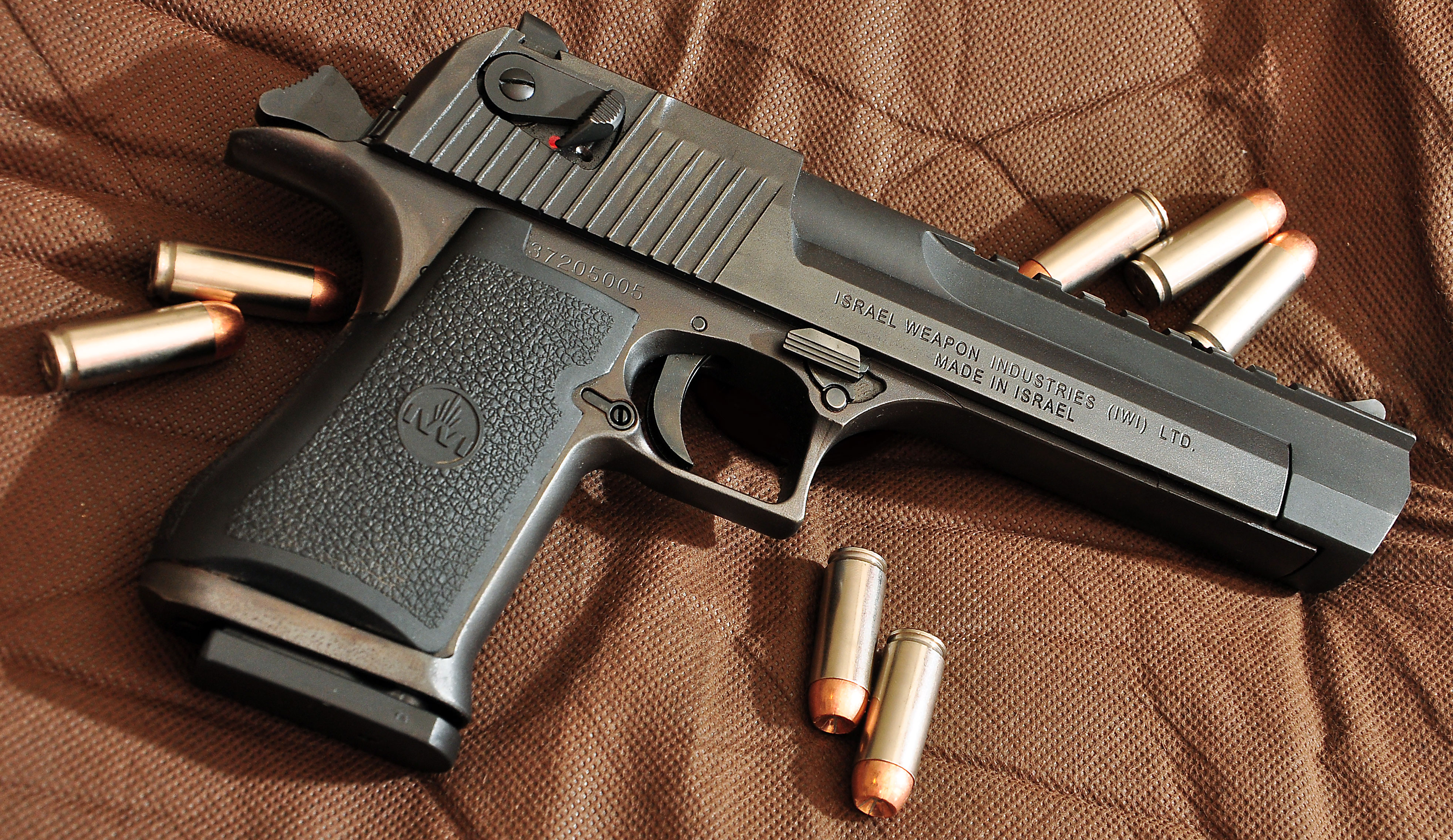
The Mark XIX — the current production Desert Eagle — is offered in .357 Magnum, .44 Magnum, .429 DE, and .50 Action Express. The .50 AE version is the one that defines the gun's reputation. The numbers are genuinely staggering: a 325-grain .50 AE bullet leaves the muzzle at roughly 1,400 feet per second, generating around 1,449 foot-pounds of muzzle energy. The gun itself weighs 4.4 pounds unloaded. Loaded with its 7-round magazine, you're holding close to five pounds of steel, gas, and controlled explosion.
The overall length of the standard 6-inch barrel model is 10.6 inches — longer than most people's forearms. The height is 6.25 inches. The width is 1.25 inches. These are not the dimensions of a carry gun. They are the dimensions of a statement.
The Rivals: Other Hand Cannons That Challenge the Crown

The Desert Eagle's most dangerous rival arrived in 2003, when Smith & Wesson introduced the Model 500 chambered in .500 S&W Magnum. The comparison is humbling for the Desert Eagle. The .500 S&W Magnum generates 2,877 foot-pounds of muzzle energy with 500-grain loads — nearly double the Desert Eagle's output. The S&W 500 is a five-shot revolver built on Smith & Wesson's massive X-Frame, and it holds the title of most powerful production handgun cartridge in the world.
Other notable hand cannons in this class include the Taurus Raging Hunter in .460 S&W Magnum, the Ruger Super Redhawk in .454 Casull, and Magnum Research's own BFR (Biggest, Finest Revolver) chambered in .45-70 Government — which, with hot Buffalo Bore loads from a 10-inch barrel, can exceed 3,000 foot-pounds of muzzle energy. In raw power terms, the Desert Eagle is not even the largest animal in the semi-auto zoo — but it remains the only semi-auto that comes close to these revolver monsters, and that distinction is what made it a legend.
The Deagle: Gaming's Most Beloved Sidearm
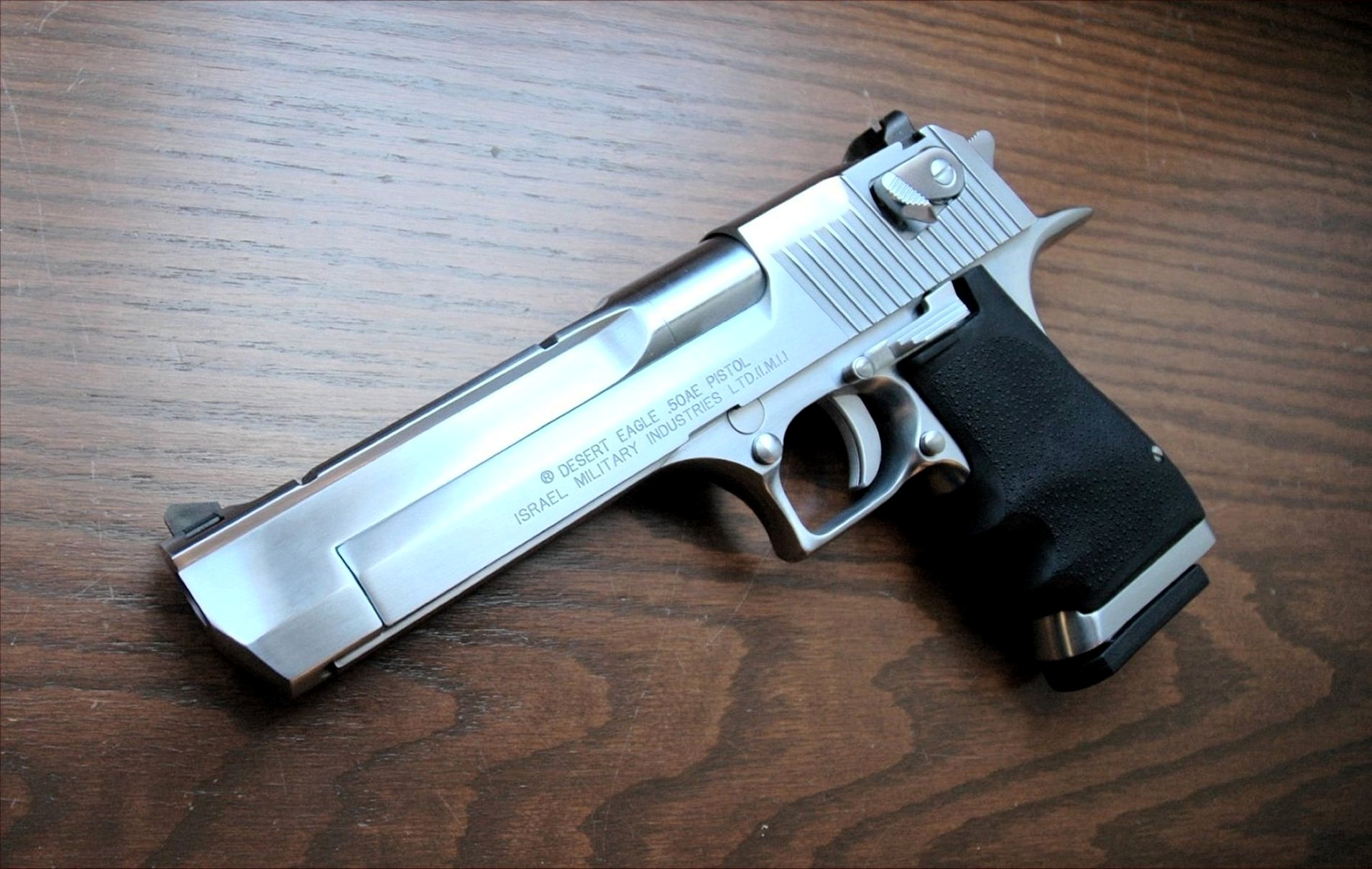
No firearm has benefited more from digital exposure than the Desert Eagle. In the gaming world, it goes by one name: the Deagle. And for an entire generation of players, the Deagle was the ultimate sidearm — not because it was realistic, but because it was devastating in exactly the way games reward.
The pivotal appearance came in Counter-Strike, first released in 2000. The Desert Eagle was the only pistol that could kill an armored, helmeted opponent with a single headshot — a mechanic that made it worth buying over any other secondary weapon despite its high cost in-game. Mastering the Deagle became a skill badge: the gun punished spray-firing and rewarded precision, making every successful headshot feel earned. The pistol's massive recoil in-game meant players had to let the crosshair settle between shots — a mechanical challenge that separated skilled players from casual ones.
Beyond Counter-Strike, the Desert Eagle appeared in virtually every major shooter franchise: Grand Theft Auto: San Andreas, GTA V, Resident Evil, Far Cry, Tomb Raider, Call of Duty, Battlefield, and dozens more. In nearly every appearance it serves the same narrative function: this is the gun carried by someone who doesn't need to be subtle. Its visual language — massive, angular, unmistakably powerful — communicates threat instantly, which is exactly what game designers want from a secondary weapon that players aspire to carry.
Magnum Research understood this dynamic early and actively cultivated Hollywood and gaming relationships throughout the 1990s and 2000s. The strategy worked. The Desert Eagle nickname "Deagle" originated in the Counter-Strike community and has since spread into mainstream English. A generation of players grew up knowing the Desert Eagle by nickname before they ever saw one in real life — and that cultural imprinting is worth more to a manufacturer than any number of tactical contracts.
Why You Cannot (and Should Not) Carry This Gun Every Day

Experienced shooters who have actually tried to carry the Desert Eagle daily agree on one thing: it's a memorable experience for all the wrong reasons. The .50 AE model weighs 4.4 pounds unloaded. Add a loaded 7-round magazine and you're carrying the weight of a small brick on your hip all day. The gun is 10.6 inches long and 6.25 inches tall — dimensions that make concealment under anything less than a heavy overcoat essentially impossible.
The holster problem is real. Standard holster systems aren't designed for a gun this size, and purpose-built Desert Eagle holsters are expensive and limited in design options. Open carry of the gun is legal in many U.S. states, but the social calculus of walking through a grocery store with a .50 AE pistol strapped to your thigh is its own conversation. Beyond the legal and social complexity, the physical strain of all-day carry with that weight and those dimensions causes real fatigue — lower back strain, shoulder discomfort, and the persistent threat of the gun printing through clothing or shifting out of the holster.
Then there's the operational reality. The Desert Eagle's gas-operated mechanism is sensitive to limp-wristing — the gun requires a firm, locked-wrist grip to cycle reliably. Under stress, when fine motor skills degrade and grip tension fluctuates, this becomes a meaningful liability. Its single-action trigger also means it must be carried with the hammer cocked and safety engaged — a configuration that requires training and discipline to handle safely under pressure.
The ammunition cost is another factor. .50 AE rounds typically run $2–4 per cartridge at retail. Maintaining proficiency with a Desert Eagle means spending significantly more per practice session than with any 9mm or even .45 ACP equivalent. For a gun that holds seven rounds and is impractical to carry, the math doesn't favor choosing it as a defensive tool.
An Icon That Earns Its Status
The Desert Eagle has always been more symbol than tool. It was engineered with ambition, refined with craftsmanship, and catapulted to global fame by Hollywood prop masters and game designers who recognized its visual power. It is genuinely excellent at what it was designed to do: chamber the most powerful semi-automatic cartridge in production and do so reliably, impressively, and with a silhouette that nobody forgets.
It won't fit in your waistband. It will bankrupt you at the range. And if you try to carry it concealed, you'll know about it within the first hour. But as a range gun, a collector's piece, and one of the most culturally significant firearms ever manufactured, the Desert Eagle has earned every bit of its legendary reputation — one digital headshot at a time.
Sources: Wikipedia — Desert Eagle | Magnum Research Inc. | American Rifleman | Counter-Strike Wiki | GTA Wiki | TheGunZone | HandgunHero
Written by
Eugene Warren
The Gun Database contributor