
Command Palette
Search for a command to run...
Command Palette
Search for a command to run...
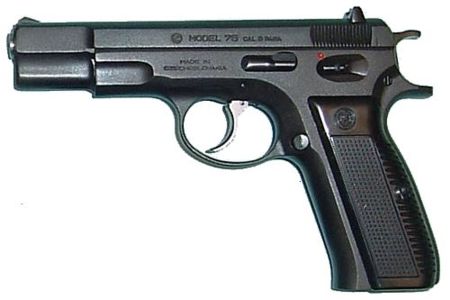
The CZ-75: How a Czechoslovak Masterpiece Became the World's Most Copied Pistol
Born behind the Iron Curtain in 1975, the CZ-75 became the most copied pistol design in history — and still the standard by which every steel-framed handgun is measured.

One Gun to Rule Them All
In the world of semi-automatic pistols, very few designs have earned the word "masterpiece" without irony. The CZ-75 is one of them. Introduced in 1975 by Czechoslovakia's Česká Zbrojovka factory, it arrived at a moment when the global handgun market was on the cusp of a revolution — the transition from revolvers and single-stack pistols to high-capacity double-action automatics. The CZ-75 didn't just participate in that revolution. In many ways, it defined it. Today, five decades after its debut, the CZ-75 remains in production, remains in active law enforcement service around the world, and remains the template against which virtually every double-action steel-framed pistol is measured. No other handgun design of the 20th century has been as widely copied — legally or otherwise — by so many manufacturers in so many countries.
Born Behind the Iron Curtain: Česká Zbrojovka and Uherský Brod
The CZ-75's birthplace is the Moravian town of Uherský Brod in what was then communist Czechoslovakia. Česká Zbrojovka — literally "Czech Armory" — had been manufacturing firearms since 1936, when it relocated to Uherský Brod from Strakonice as the threat of Nazi occupation grew. By the postwar period, the factory was producing arms under state direction for Warsaw Pact military contracts, primarily chambered in Soviet-standard calibers like 7.62x25mm Tokarev and 9x18mm Makarov. The Western 9x19mm Parabellum cartridge, used by NATO forces and most of the non-communist world, was considered irrelevant for domestic service.
That distinction — that the CZ-75 was chambered for a Western cartridge and intended purely for export — is crucial to understanding the gun's early history. In 1969, CZ management approached one of its most celebrated retired designers and asked him to create something extraordinary: a 9mm pistol so refined and competitive that it could be sold on the international market to earn hard Western currency. The result would be the most influential pistol design of the second half of the twentieth century.

The Koucký Brothers: Engineers of a Legend
The men behind the CZ-75 were Josef and František Koucký, brothers whose careers at Česká Zbrojovka spanned decades and whose combined output included some of the finest Czech small arms ever produced. František (1907–1994) had already designed the ZK-383 submachine gun, the ZKK-600 hunting rifle series, and the ZKM-452 bolt-action rimfire — a rifle still in production in modified form today. He was, by the time CZ management approached him, officially retired. He came back for one more project.
Working from first principles, the Koucký brothers studied every major service pistol of the era and identified what they considered the key failure of the CZ-75's contemporaries: the choice between a Browning-pattern slide-over-frame design (like the Beretta) or a frame-over-slide design (like the SIG P210 or the eventual Walther P88) was a false dichotomy. Their design used a rail system in which the slide rode inside the frame rather than outside it — an arrangement that lowered the bore axis relative to the shooter's grip, reduced muzzle flip, improved the natural point of aim, and created a pistol that felt, in the hands of most shooters, more controllable and more intuitive than anything else available at the time. Four patents were filed to protect the design. None of them ultimately proved enforceable.
A Wonder Nine Before Wonder Nines Were Cool
When the CZ-75 debuted in 1975, the term "wonder nine" had not yet been coined. But the CZ-75 embodied everything that phrase would come to mean: a double-action/single-action 9mm pistol with a staggered-column magazine offering capacity that double-stack designs — 15 rounds in the standard magazine — dramatically exceeded the seven or eight rounds typical of the Browning Hi-Power, and the six of most revolvers. It was all-steel, hammer-forged, and built to tolerances that gave it exceptional out-of-the-box accuracy. The trigger, both in its initial double-action pull and the crisp single-action subsequent pulls, was widely praised as among the finest available on any production pistol.
The frame-mounted safety allowed the gun to be carried "cocked and locked" — hammer back, safety on, ready for an immediate single-action first shot — which was a significant tactical advantage compared to pistols that required a longer double-action trigger pull for the first round. Shooters who tried the CZ-75 in the late 1970s and early 1980s almost universally came away impressed. Gun writers in Western Europe and in the United States — where the pistol was not yet legally importable — wrote about it in near-reverential terms. It was, many concluded, simply better than what the market was offering.
The Patent Blunder That Gave the World a Free Blueprint
Here is where history takes a turn that František Koucký reportedly found deeply painful. The four patents protecting the CZ-75 design were initially classified as secret by the Czechoslovak government, which was concerned about Western intelligence agencies studying the firearm's construction. When the government decided to declassify the patents in 1979 to facilitate export sales, something went wrong in the process: the patents were declassified but never properly filed for international protection under the Patent Cooperation Treaty system. The window for international patent registration closed.
The result was one of the most consequential intellectual property failures in firearms history. The CZ-75's mechanism entered the public domain in most of the world's major manufacturing jurisdictions. Any gunmaker who wanted to build a CZ-75 clone — legally, without license fees, without agreements with Česká Zbrojovka — could do so. And they did. By the mid-1980s, manufacturers in Italy, the United States, Germany, Switzerland, Turkey, Israel, and elsewhere were producing CZ-75 derivatives. Česká Zbrojovka received nothing for any of them.
The Clone Army: How the World Got a CZ-75 of Its Own
The most significant of the CZ-75 clone manufacturers was the Italian firm Tanfoglio, based in Gardone Val Trompia near Brescia — Italy's historic firearms manufacturing heartland. Tanfoglio began producing CZ-75 variants in the early 1980s and became the dominant supplier of CZ-pattern pistols to markets where the original was unavailable or too expensive. Their guns were imported into the United States under multiple brand names, most prominently through European American Armory as the EAA Witness series, which became a bestseller in its own right. Tanfoglio also supplied components and complete pistols to other firms, including the Israeli company IMI, which used a Tanfoglio-based platform to build the Baby Eagle — the gun exported to the US market that was structurally identical to the Jericho 941.
Springfield Armory imported the CZ-75 clone as the P9 series. Swiss firm Sphinx produced high-end CZ-75 derivatives regarded as some of the finest production pistols ever made. Turkish manufacturers including Sarsilmaz and later Tisas built their own variants, some of which entered law enforcement service across the Middle East and Africa. In China, Norinco produced the NZ-75. In the Philippines, the design influenced local production. By the 1990s, more CZ-75 pattern pistols were being made by other companies than by Česká Zbrojovka itself — a situation almost without parallel in firearms history.

Law Enforcement and Military Adoption
The CZ-75 itself — not just its clones — has served in the armed forces and police services of a remarkable number of countries. The Czech Republic and Slovakia adopted it as their standard military sidearm following the dissolution of Czechoslovakia in 1993. Turkey's security forces have used CZ-75 pattern pistols extensively. It has served in the arsenals of forces in India, Thailand, Argentina, and across Central and Eastern Europe. The CZ-75B — a firing pin safety variant introduced in 1994 — became particularly widespread in export markets, addressing institutional concerns about drop-safety that some agencies had raised about the original design.
In sport shooting, the CZ-75 became dominant. Its combination of low bore axis, crisp trigger, and steel-frame mass absorption made it the preferred platform for IPSC and IDPA competition shooters across multiple divisions for decades. The SP-01 variant, introduced in 2004 with an extended rail and improved ergonomics, became the single most popular competitive shooting handgun in many European markets. CZ's Shadow line of competition-tuned pistols, built on the SP-01 frame, are today considered among the finest out-of-the-box competition pistols available at any price.
Why It Became a Staple: The Answer Is in the Shooting
Every analysis of the CZ-75's enduring popularity eventually circles back to the same point: it simply feels better to shoot than almost anything else. The low bore axis — a direct result of the slide-inside-frame design — reduces muzzle rise in a way that is immediately perceptible to any shooter who picks one up. The grip geometry, the balance of an all-steel pistol with meaningful mass, and the quality of trigger available even from the factory combine to create an experience that rewards the shooter rather than requiring compensation. It is a gun that makes average shooters better and good shooters excellent.
That the design is now fifty years old and still in active production — still being adopted, still winning competitions, still being cloned by manufacturers who could choose any other pattern — is the most eloquent testimony to the Koucký brothers' achievement. Behind the Iron Curtain, without access to Western ammunition or testing ranges, without international patent protection, working to produce something that would earn foreign currency for a state economy, two brothers from Moravian Czechoslovakia built the best pistol in the world. The world figured that out eventually.
Sources: Wikipedia – CZ 75 | American Rifleman | Gun Digest | All4Shooters | Gun Mag Warehouse | Česká Zbrojovka official history
Written by
Eugene Warren
The Gun Database contributor