
Command Palette
Search for a command to run...
Command Palette
Search for a command to run...
A Brief History of the Colt 1911: America's Most Iconic Pistol
From the Philippine-American War to modern competition shooting, the Colt 1911 has shaped firearms history for over a century. Here's how it evolved.

The Birth of a Legend: Origins of the Colt 1911 (1899–1911)
Few firearms in history have earned the cultural, military, and mechanical respect afforded to the Colt M1911. Born from the battlefield experience of the Spanish-American War and the Philippine-American War, the 1911 was a direct answer to a critical question: was the .38 Long Colt powerful enough to stop a determined adversary? The answer, tragically proved in the jungles of the Philippines from 1899 to 1902, was no. American soldiers encountered Moro warriors who, even after sustaining multiple .38 caliber wounds, continued to fight. The U.S. Army's response was to commission a new sidearm — one chambered in a substantially heavier caliber, .45 ACP.

John Moses Browning and the Army Trials (1906–1911)
The architect of the 1911 was none other than John Moses Browning, arguably the most prolific and influential firearms designer in American history. Browning had already delivered the Model 1894 lever-action rifle and the Browning Auto-5 shotgun when he turned his attention to a semi-automatic pistol capable of chambering a powerful .45 caliber cartridge. His design — the Model 1905, later refined through successive iterations — was entered into the U.S. Army's competitive pistol trials beginning in 1907. The trials were rigorous. Competing designs from manufacturers including Savage Arms were subjected to grueling endurance and reliability tests. In the decisive 1910 trials, Browning's Colt design fired 6,000 rounds without a single malfunction, pausing only to cool the barrel with water or oil. The Savage pistol, its closest competitor, recorded 37 malfunctions in the same test. On March 29, 1911, the U.S. Army officially adopted the Colt Government Model as the Model 1911, chambered in .45 ACP.
World War I Service and the Pistol's Combat Debut (1911–1918)
The 1911 saw its first large-scale combat deployment during World War I, where it quickly developed a reputation for stopping power and rugged dependability. American soldiers and officers carried it through the trenches of France, and its reliability under adverse conditions — mud, dirt, and sustained use — was repeatedly validated. Notable acts of valor were recorded with the pistol: Sergeant Alvin York reportedly used a 1911 to neutralize multiple German soldiers during his legendary 1918 engagement in the Argonne Forest. By the end of the war, hundreds of thousands of pistols had been produced, primarily by Colt's Patent Firearms Manufacturing Company. The 1911 had moved from a promising design to a battle-hardened standard — and it had only just begun its service life.

The M1911A1: Refinements After 15 Years of Service (1924–1926)
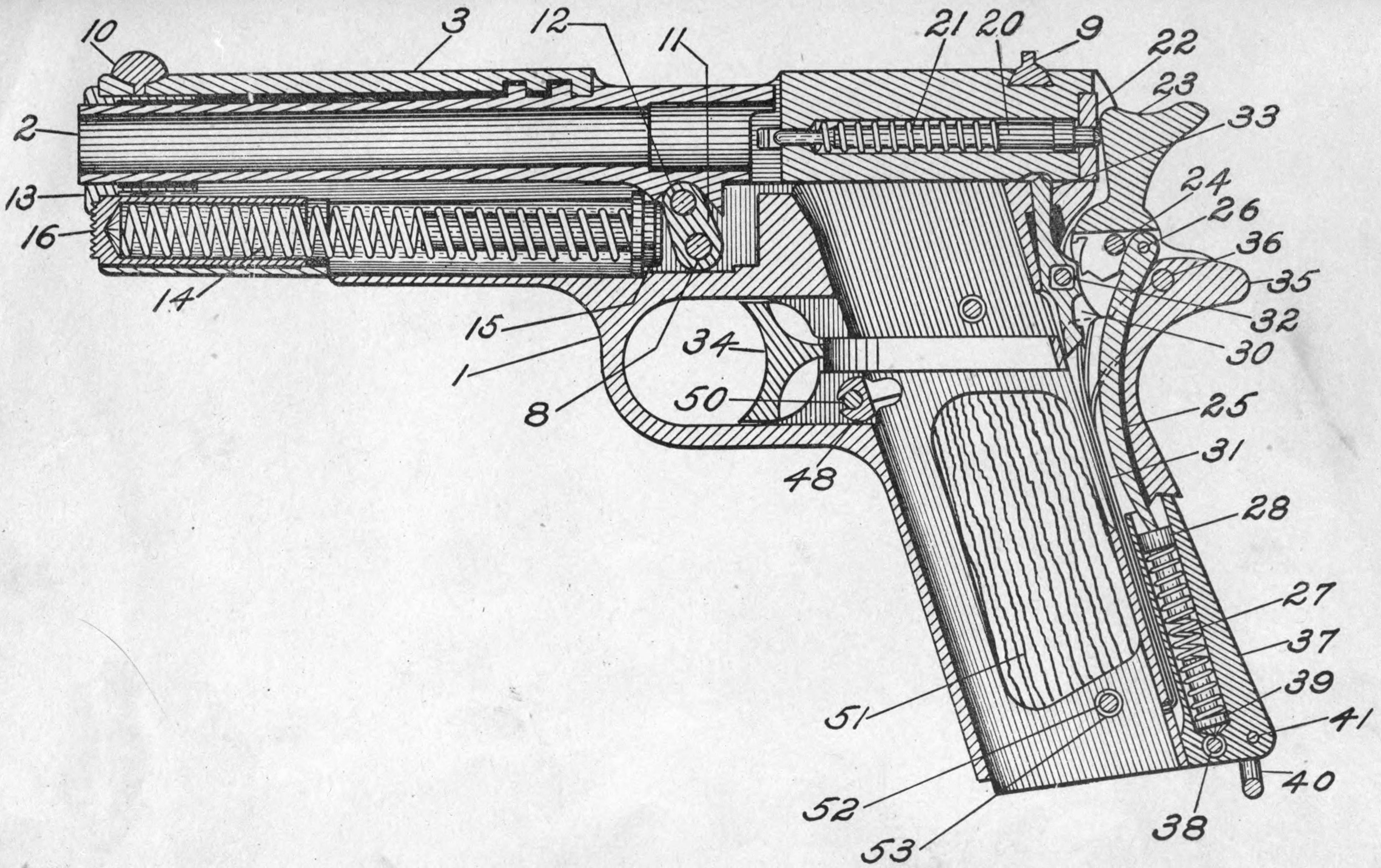
By the mid-1920s, with over 700,000 M1911s produced, the U.S. military had accumulated substantial feedback from soldiers about ergonomics and handling. A series of modifications was approved and codified in the updated Model M1911A1, formally adopted in 1926. The changes were deliberate and targeted: the trigger was shortened for better reach by smaller hands, the mainspring housing was arched to improve grip angle, the grip safety spur was elongated to prevent hammer bite, the front sight was widened for faster target acquisition, the hammer spur was shortened to reduce snagging, and frame cutouts behind the trigger were added for improved finger placement. None of these changes altered the fundamental operating mechanism — Browning's short-recoil, tilting-barrel system remained untouched. The M1911A1 was not a reinvention; it was a refinement, and a highly effective one.
World War II Mass Production: A Nation Armed (1941–1945)
The scale of M1911A1 production during World War II was staggering. With Colt unable to meet the demand alone, the U.S. government licensed the design to multiple manufacturers. Companies including Remington-Rand, Ithaca Gun Company, and Union Switch & Signal produced the pistol alongside Colt. By war's end, approximately 1,878,742 M1911A1 pistols had been manufactured across these facilities. Remington-Rand alone produced nearly 900,000 units — more than Colt itself during the same period. In total, combining WWI and WWII production across all manufacturers, over 2.7 million M1911/M1911A1 pistols were built. The pistol was issued not only to U.S. forces but also supplied to Allied nations under Lend-Lease arrangements, cementing its international presence long before the civilian market took hold.
Korea, Vietnam, and Decades of Continued Service (1950–1985)
The M1911A1 served American forces through every major conflict of the 20th century. In Korea, it remained the standard officer and NCO sidearm. In Vietnam, where close-quarters engagements were common, the pistol's .45 ACP cartridge continued to prove effective. By this era, individual armories were carrying pistols that were often 20 to 30 years old — field-worn, rebuilt, and re-issued multiple times over. Maintenance soldiers frequently assembled pistols from mixed-lot parts across different manufacturers, yet the design's loose tolerances — intentional in Browning's original work — ensured they continued to function. This was not a flaw; it was a feature. Critics of the platform emerged primarily in discussions of magazine capacity (7+1 rounds versus the higher-capacity European designs emerging in the 1970s) and interoperability with NATO allies. By the early 1980s, the search for a replacement was underway.
Replacement and Legacy: The Beretta M9 and Beyond (1985–Present)
On January 14, 1985, the U.S. military officially adopted the Beretta M9 as the replacement for the M1911A1, chambered in 9mm NATO — chosen partly for ammunition commonality with allied forces and partly for the M9's 15-round double-stack magazine. The 1911 was formally retired from general issue. Yet it never fully disappeared from service. The U.S. Marine Corps fielded the M45A1 Close Quarter Battle Pistol — a modernized, rail-equipped 1911 variant produced by Colt — for MARSOC and other specialized units well into the 2010s. The FBI's Hostage Rescue Team and various special operations elements continued to use 1911-pattern pistols for their inherent accuracy and trigger characteristics. In the civilian market, the 1911 experienced a renaissance rather than a retirement. Manufacturers including Springfield Armory, Kimber, Rock Island Armory, Dan Wesson, and Wilson Combat offer hundreds of 1911 variants today — from entry-level range pistols to bespoke competition pieces costing several thousand dollars.

What the 1911 Means for Firearms Owners Today
For modern firearms enthusiasts, the Colt 1911 occupies a singular position. It is simultaneously a historical artifact and a living platform — still manufactured, still carried, still competed with, and still debated. Its single-action trigger, widely regarded as one of the finest production triggers available, gives it an edge in precision shooting that continues to attract competitive shooters. Its .45 ACP chambering retains devoted advocates who cite its terminal performance. The aftermarket ecosystem — triggers, sights, grips, barrels, frames — is among the most developed in the industry, allowing owners to customize a 1911 to nearly any specification. More than anything, the 1911 endures because John Browning got the fundamentals profoundly right in 1911. Over 115 years later, the world's gun manufacturers are still trying to build a better version of it.
Sources: U.S. Army Center of Military History | Colt's Manufacturing Company | National Firearms Museum | Wikimedia Commons | Journal of Military History
Written by
Eugene Warren
The Gun Database contributor