
Command Palette
Search for a command to run...
Command Palette
Search for a command to run...
9mm vs. .45 ACP: The Age-Old Debate That Still Divides Shooters
9mm or .45 ACP? We break down the ballistics, stopping power, recoil, and FBI research behind the most passionate debate in the firearms world.

The Debate That Has Divided Shooters for Decades
Ask any experienced shooter which is better — the 9mm or the .45 ACP — and you'll likely ignite a conversation that ends somewhere between passionate argument and grudging mutual respect. This is one of the oldest and most fiercely contested debates in the firearms world, and for good reason. Both cartridges have impressive track records, loyal fan bases, and real-world data to back them up. Rather than declaring a winner, this article lays out the facts so you can decide for yourself.
A Tale of Two Cartridges: How They Came to Be
The 9mm Parabellum — also called 9x19mm or 9mm Luger — was developed by Austrian designer Georg Luger in 1901 for the Luger semi-automatic pistol. It was adopted swiftly by the German military and became the standard pistol cartridge throughout World War II. Its name comes from the Latin phrase Si vis pacem, para bellum: "If you seek peace, prepare for war." Compact, efficient, and versatile, the 9mm spread across Europe and eventually became NATO's standard handgun cartridge.
The .45 ACP (Automatic Colt Pistol) followed just a few years later, born from a very different need. After reports emerged from the Philippine-American War that the standard .38 Long Colt cartridge was failing to stop Moro warriors in close combat, the U.S. Army launched a search for something more powerful. John Moses Browning answered in 1904 with a new cartridge and a new pistol design — what would eventually become the iconic M1911. The .45 ACP fired a wide, heavy bullet that transferred enormous energy on impact. It was adopted by the U.S. Army in 1911 and served as the American military's standard sidearm cartridge for over 74 years.
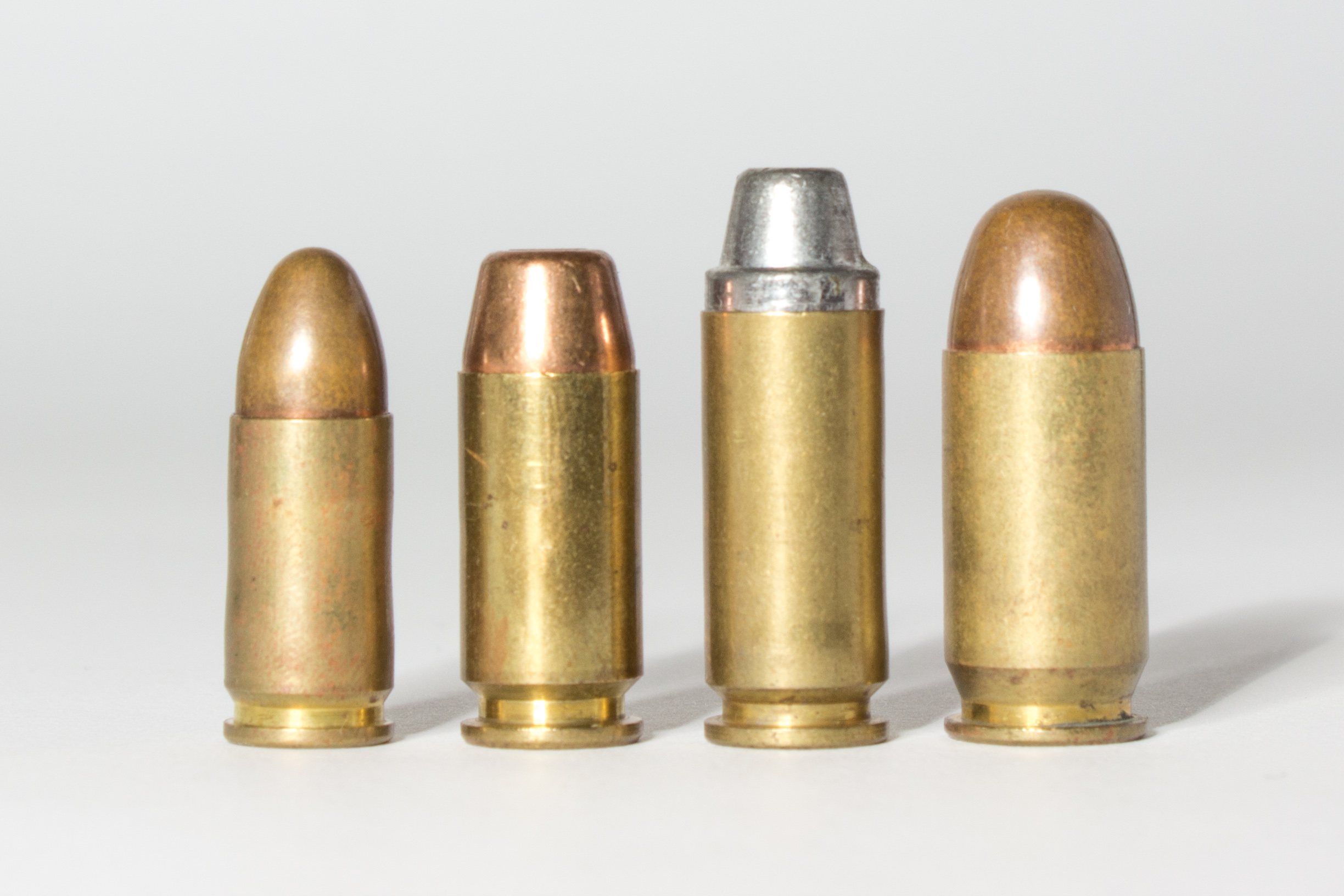
Raw Ballistics: By the Numbers
The physical differences between these two rounds are significant. The 9mm fires a lighter bullet — typically 115 to 147 grains — at a higher velocity, usually between 1,100 and 1,300 feet per second, producing roughly 350 to 450 foot-pounds of muzzle energy. The .45 ACP, by contrast, launches a much heavier projectile — 185 to 230 grains — at a slower pace, around 800 to 950 feet per second, generating 350 to 500 foot-pounds of energy depending on the load. The .45 ACP wins on bullet diameter (roughly .45 inches versus .355 inches) and momentum, while the 9mm wins on velocity and flat trajectory. Neither has a decisive ballistic edge on paper.

Stopping Power: Does Bigger Always Mean Better?
The .45 ACP's traditional reputation rests on its large, slow bullet creating a wide wound channel and transferring maximum energy to a target. Proponents argue that a .45-caliber hole is simply bigger than a 9mm hole, and in a self-defense scenario, size matters. For much of the 20th century, this logic was hard to argue with — the 9mm's smaller bullet was often criticized for over-penetration and inconsistent expansion with older ammunition designs.
But bullet technology has changed everything. Modern hollow-point 9mm ammunition reliably expands to over double its original diameter and achieves consistent penetration depths of 12 to 18 inches in ballistic gelatin — meeting or exceeding FBI standards. Premium defensive loads from brands like Federal HST, Speer Gold Dot, and Hornady Critical Defense have closed the performance gap dramatically. Today, the stopping power difference between a quality 9mm hollow point and a quality .45 ACP hollow point is negligible in real-world defensive scenarios. The FBI's own testing confirmed this: modern 9mm loads match the terminal performance of both .40 S&W and .45 ACP.
Recoil and Control: Where the 9mm Pulls Ahead
This is where the 9mm earns its strongest argument. The .45 ACP generates approximately 50% more free recoil energy than the 9mm from a comparable handgun platform. That additional recoil slows follow-up shots, increases shooter fatigue over extended training sessions, and can make accurate rapid fire more difficult — especially for newer shooters or those with smaller hands or less grip strength. The 9mm's lighter, faster recoil impulse allows for faster target reacquisition and tighter shot groups at speed. In law enforcement qualification testing, officers consistently score higher with 9mm than with larger calibers, a fact that influenced the FBI's historic shift back to 9mm in 2014 after years carrying .40 S&W.

Capacity, Concealability, and Cost
The 9mm's smaller case dimensions translate directly into real-world advantages. A full-size 9mm service pistol like the Glock 17 holds 17+1 rounds, while its .45 ACP-chambered counterpart, the Glock 21, holds 13+1 in a noticeably thicker frame. For concealed carry, that difference in grip girth becomes meaningful — many shooters with average or smaller hands find .45 ACP pistols harder to conceal and less comfortable to draw. Beyond capacity, 9mm ammunition is consistently less expensive than .45 ACP, often by 20 to 40 percent. For regular practice and training — which directly determines your performance under stress — that cost savings adds up to thousands of rounds a year.
What the FBI Concluded
The FBI's 2014 decision to transition from .40 S&W back to 9mm is the single most researched and documented data point in this debate. After extensive ballistics testing, the bureau concluded that modern 9mm hollow-point ammunition achieves terminal performance equivalent to both .40 S&W and .45 ACP. The advantages — lower recoil, higher capacity, better agent qualification scores, reduced cost — made 9mm the rational choice for a professional law enforcement organization. The U.S. military never returned to .45 ACP after adopting the M9 in 1985, and the newer M17/M18 (SIG Sauer P320) continues in 9mm. Globally, 9mm is NATO's standard and the dominant choice for military and law enforcement.
Which One Should You Choose?
If you prioritize raw bullet diameter and the psychological comfort of a historically proven man-stopper, the .45 ACP remains an excellent and entirely viable choice for home defense or range shooting. The 1911 and similar platforms are beloved for their ergonomics, single-action triggers, and undeniable character. If you prioritize capacity, controllability, cost of training, and the endorsement of modern ballistic science, the 9mm is the more practical option for most shooters — especially for everyday carry. The honest answer is that with quality ammunition in either caliber, you are not undergunned. The debate lives on not because one round is clearly better, but because both are genuinely good — and shooters love arguing about it either way.
Sources: FBI Ballistics Study (2014) | Pew Pew Tactical | USCCA | Ammo.com | Outdoor Life | Rock Island Auction Company
Written by
Eugene Warren
The Gun Database contributor